
How to Move From AI Pilots to Real Business Impact
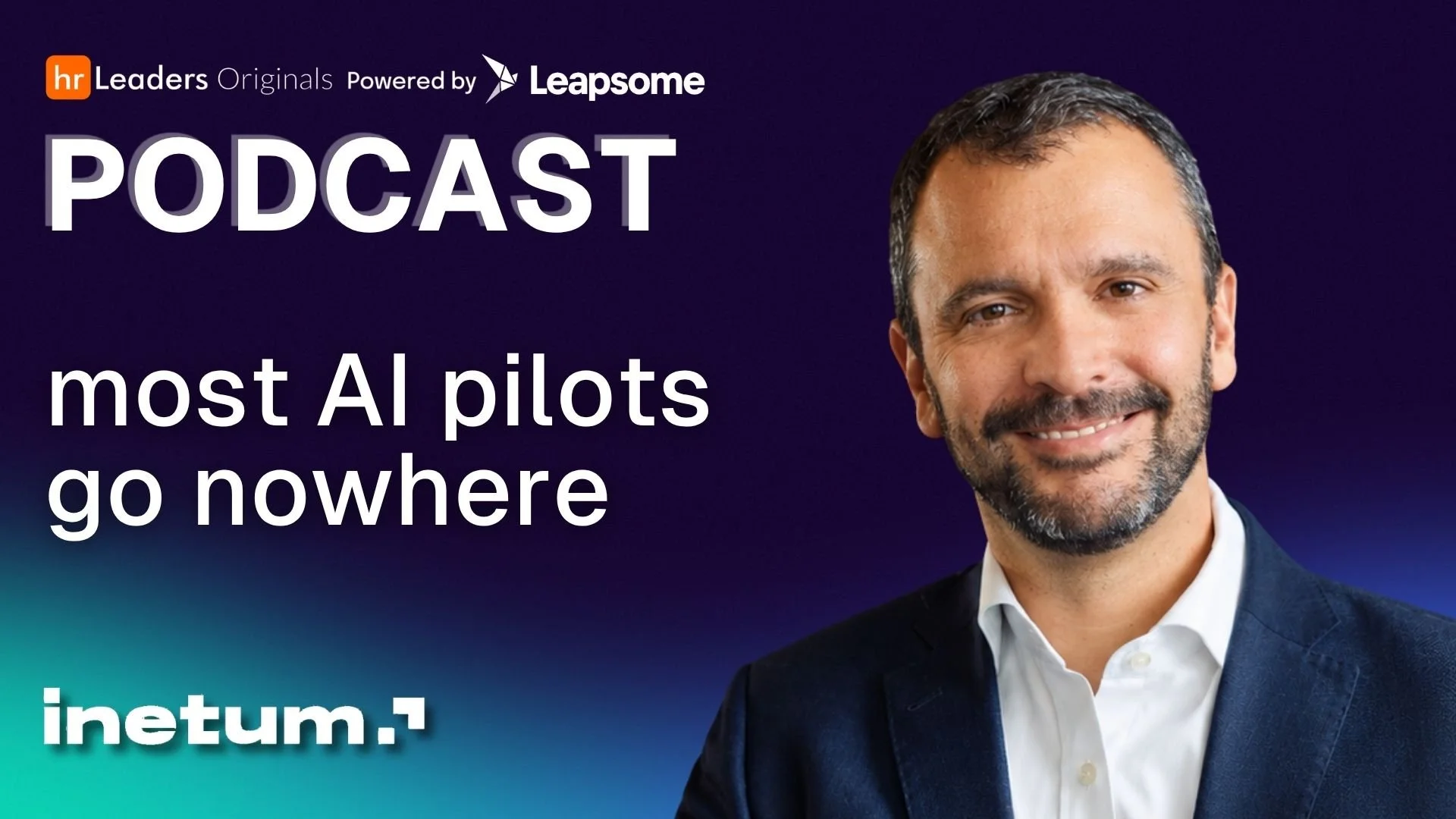
What if the biggest mistake companies are making with AI is trying to improve individual tasks instead of redesigning the entire process?
In this episode of the HR Leaders Podcast, I sit down with Bruno Da Sola, Group Chief People Officer at Inetum, to explore what changed when the company moved beyond scattered AI experiments and started redesigning critical end-to-end workflows.
For HR leaders, the bigger lesson is not simply to add more AI tools. It is to identify the workflows that matter most to the business, redesign them around outcomes, and be transparent with employees about what the change means for their work.
5 things you’ll learn from this episode:
Why asking employees for individual AI use cases did not create the business impact Bruno expected
The change in approach that helped Inetum move from scattered experimentation to end-to-end AI transformation
How one workforce process went from taking weeks to producing results in minutes
Why Bruno believes the most powerful AI workflows still need carefully chosen human intervention
The mistake HR leaders may be making by choosing small, low-impact processes to prove the value of AI
81% of the fastest-growing companies already require AI skills in People roles. Will your HR team lead the shift or be left catching up?
Leapsome’s six-month Agentic HR Accelerator gives your team a practical path from AI ambition to implementation.
With expert guidance, a dedicated point of contact and a cohort of forward-thinking HR leaders, your team can launch three practical AI use cases, migrate its HRIS in as little as two weeks and earn Agentic HR certification.
Sign by 31 December and the €24K Accelerator plus Leapsome’s Agentic HRIS Foundation are included at no extra cost when you choose a Talent module.
[01:21:15:03 - 01:21:27:22]
Perfect. All right. JC, you good? All right. All right, cool. So I'm just going to say to start the episode, like Bruno, welcome to the show, right? And then we'll jump in, but we have like a video intro we do after the episode.
[01:21:29:00 - 01:21:41:07]
And then we should go for about 30 minutes. And then, yeah. Is the song okay for you or should I put my earpods? That sounds great. Sounds great? Okay. Yeah. Yeah. The team's giving me a thumbs up.
[01:21:42:11 - 01:21:55:15]
(Laughs) It sounds good. So just try not to touch the desk that much. Yeah. It's just going to be a habit. It's just because of the desk, the camera's on there, it's like very shaky. So that's fine. All right, let's do this.
[01:21:57:01 - 01:22:08:05]
Bruno, welcome to the show. How are you doing, my friend? I'm good and you? Yeah, good. Yeah. I'm like timed flying by as always. I don't, summer seemed like it was a year ago.
[01:22:09:09 - 01:23:39:17]
Things are going way too fast. How are things on your end? I think everything is good, personally and professionally, of course. Professionally, big moment. Big moment for Inetum. We have been working in this specific project, Private Equity One, with Bain Capital for four years, almost five. So lots of transformation, lots of ambition also. So it has been great. And I was really happy to see also that HR was very important to that transformation, to how to help the company grow. Of course, specifically in a company like Inetum, where people are assets. So we need to be focusing really hard on that point. Well, good to hear that. And over the years, many, many years of doing this, one of the things I've seen, that if companies bringing HR too late in the process, you see the knock-on effect that that has. So the fact that HR is front and center from the very beginning of the process is great. And it's a good sign, right? Yeah, and always it's coming also from the relation you are being able to create with the CEO. That's the first point of everything. And it was the case with the CEO of Inetum, Jacques Poumot, and then the executive committee, and then it flows all the way down in the organization. Yeah, before we jump in, tell everyone a little bit about the organization, if they're maybe not aware, and then a little bit about your personal background and journey.
[01:23:40:22 - 01:23:52:15]
Sure, so Inetum is a company of IT services present in 20 countries, more than 2.5 billion revenue,
[01:23:53:20 - 01:24:01:13]
French company-based at the really beginning, and part of the bank capital portfolio for four years.
[01:24:02:13 - 01:24:53:11]
So basically we help our clients to drive their own IT system, outsourcing applications, everything, integration also of tools, which is really important and really working well across the world. So that's for the company. On my personal background, what I can tell you, so I'm a French people, French person living in Paris. I've been working 10 years at Sage, the British software company, and then I went to IT services company like Akodes, and then Inetum where I'm chief HR officer for almost six years actually already. How many employees do you have, by the way? We have 25,000 people. Just 25,000.
[01:24:54:13 - 01:27:54:19]
Yeah, just 25. And growing fast, right? Yeah, so France and Spain are the main countries, and then we are present in Belgium, Portugal, Eastern Europe, and also Latin America when we have more than 2,000 people actually. Nice. It must be a fascinating landscape for you in the business right now with all of the change and transformation along with obviously AI coming into the picture. Exactly, and actually AI, that's the very interesting point. We are leaving AI as a very important disruptive topic in our business and also as a company. So when I'm discussing with a lot of HROS, we have exactly the same problem on how do I implement AI in my own company? How do I become more effective, et cetera? And at the same time, we need to be able to sell it to our clients and to impact our projects and the way we are managing projects for our clients. It is very interesting because from the very beginning, we decided to be able to show our clients that we are implementing it internally. So then you can show the efficiency, how we can work better, et cetera, et cetera. Yeah, you have such a unique lens because you're obviously internally and externally for customers with all of the hype around AI and continued hype. Where are you actually yourselves internally and your customers seeing impact and results? Exactly, that's the main point. And that's the most difficult part because actually in all companies, it's always the same. You are putting your efforts and investments on something that you are going to sell. It's very difficult to convince your own organization that you should implement AI internally in HR, finance, even in the way you are driving all the projects. If you don't have a direct impact on your revenue. So, but actually it was not a problem at CNETM. Very quickly, our CEO was advocating really strongly about AI. So there was no problem to convince the organization that for instance, in HR, we should implement it and we should be able to show the results really quickly, which was not the case, but I think that we are going to discuss it quickly. Yeah, one of the challenges I'm seeing, and this is a person even for me as well, right? It's like, where do you start? So when you spoke with your HR team, where did you start? Like, and how did you come to the decision of this is the area we're going to focus on that we believe we can have CSM ROI? Really quickly, we started with recruitment, talent acquisition, because it was the easiest one, which comes to your mind really quickly. And because recruitment is absolutely key in our business,
[01:27:55:23 - 01:28:44:13]
we recruit people, we recruit talent, and this talent is the one that we are going to put working with our clients. So this was really easy to think about. And actually the difference now we can see is that the difference between AI two years ago and now is absolutely incredible. So the point on that one is that we started with AI, also with learning really quickly, but the problem that I saw, and I was very frustrated beginning of the year about the results. During two years, we asked our people to think about the use cases that they could put in place with AI, with our own playground, which was like an internal chat GPT, for instance.
[01:28:46:05 - 01:31:22:21]
And actually people were really willing to do something, were happy to think about, okay, that use case, I could use it for myself personally every day on my day to day tasks. But actually when it comes to what is the real impact on the P&L of the company, what is the real impact on efficiency? Are we really working better, et cetera? I was really frustrated about the result because I was not really able to say, okay, that use case, for instance, looking at the resumes of people, because we have thousands and thousands of candidates working, wanted to work too far in the term. And actually the first use case was, okay, I'm going to classify my resumes really quickly by capabilities, et cetera, et cetera. But some were using it, other were not using it. And so then you cannot see the real impact. And if you are really improving your company and your organization with that. So that's why we started finally to think about the whole end-to-end process, rather than specific use cases for one person. Because when you take that end-to-end process, and when you know that process, and everyone knows that process in the company, then everything becomes easier. Easier for adoption, easier to put that in place, et cetera. And I think that this is the main advice that I had for a lot of chief people officer during the last six months, because he amazed me to see what kind of difference you can put in place. And I'm discussing with a lot of, I was telling you about this conference I attended in Paris two weeks ago. And actually a lot of see-at-shores come to you and say, okay, what did you do? How did you implement AI? I don't know where to start. I don't know how to do it, actually, because it's complicated. Everyone is working on their day-to-day tasks. And actually, I can understand, and I lived it. It's very difficult, again, to have small use cases to follow up also, because all the support functions were doing use cases. You can have also in the business part, et cetera. It's very difficult to follow up, very difficult to see the real impact. And then you need to think bigger. Finally, it's the key word. Yeah, it's interesting, because you'd think going to employees for ideas, asking them for the ideas is a good strategy. Why did that fall flat? Why do you think that that approach didn't work?
[01:31:25:15 - 01:33:26:16]
Why I think it didn't work? Yeah. Yeah, because people don't see the full picture, or maybe there's a lot of people thinking about the full picture, but actually it's very difficult. When you come to someone and say, okay, Patrick, tell me, how can I help you with AI in your day-to-day task? Oh, okay, okay, I could use for that, or I could use for that, because AI, we had a lot of long moments discussing about AI and how can AI help you to classify your emails, helps you work through the answers and things like that. Actually, this is great. This is great. But this has no impact in the P&L of the company. And if you want to be able to invest a lot of money, you need to have the efficiencies. You need to prove that it's impacting very well the growth of the company. And it's not with a use case classifying your resumes, or only that. What you need is classifying the resumes, see the capabilities you have, what are the capabilities you need, and how you make that happen in terms of workforce management. And then it made something. So I think that people were really amazed to think about that. We wanted to do that, but actually the problem for me is thinking about the usage of AI individually. It's not individual. It's again a full process. You need to identify it really closely to explain it, and then the magic can happen. Yeah, I feel like we've all made this same mistake. It's the same thing I did with every one of my teams, and I realized that everyone's working separately with separate agents, with separate sets of skills, and nothing's connected to a specific process, to a specific function. And then everyone's then working in their own ways. There's data disconnected, there's duplicate work, there's duplicate templates. But at some point I think that this is part of the change management process.
[01:33:27:23 - 01:33:39:01]
I mean, I was very frustrated, but at the same time, I think that it was absolutely needed to go through that process with people getting in touch with AI,
[01:33:40:13 - 01:34:22:09]
being able to know about it, how it works, et cetera, then working on their own stuff, and then thinking about the big picture. I think that it was part of the change management, and to be honest, everything went very, very fast. Even if I was frustrated about after two years, I mean, what's happening right now is huge. Yeah, I do think that if you would have approached them with your strategy now, they probably would have been a bit overwhelmed because they haven't had a chance to play, explore, in a safe environment beforehand, right? So in many ways, I think you're right. And two years ago, it was not possible to identify the full end-to-end process in the company. It was not possible.
[01:34:23:12 - 01:34:42:21]
I had very interesting discussion with Google, like one month ago, we were discussing with an IT guy, and he was telling me two years ago, Bruno, you were that conversation agent where you were asking things, he was answering you, and that was pretty much it.
[01:34:44:10 - 01:35:26:13]
And he told me one month ago, so it was in August. We started with an agent saying, okay, I need you to do that task and that task. Two days after, he went back to that agent, created 28 other agents. To go and do the other things. Yeah, it's crazy. Can you imagine that? I mean, we are talking about something that was absolutely not possible two years ago. So it is fine, it is part of the past that every single company needs to go. When you was at that conference, just interestingly enough, with OCH Rose, what was the most common challenge or thing that people kept bringing up?
[01:35:27:23 - 01:36:40:11]
Um... Like, specifically? Is it technically possible? Because we're hearing a lot of things, and actually, is it working? Is it high? Is it working? Is it a hype? Yeah. Is it something, I mean, everybody is talking about AI. I know, I know. At some point, it's like, okay, I want to hear about something else, clearly. You wanna see the results, right? Not just the features and the benefits, too, right? It's like, every day I see a new flashy promo video, a new announcement, and one of the things I've learned through developing software myself now with our team is whatever these companies are showing on their websites or in their promotional videos is a year, like, they're still building that. They haven't, most of the 90% of the time, that's what they're working on, not what's actually in the market, but they're under so much pressure to show that they're ahead that they kind of just push that out, if that makes sense. Yeah, yeah. So you mentioned before that, you know, and this is quite a big number, right? You've looked at your workforce management and you've made that 95% faster in six weeks. If most people heard you say that, they wouldn't believe you. So walk us through, and if you could break it down, what does that look like?
[01:36:43:07 - 01:39:25:09]
So we have this workforce management end-to-end process, which means that basically you have your salesperson at client's premises. The client tells you, I need three developers on Java with that background, et cetera. Normal process, the sales guy comes back to the company, discuss with HR, discuss with the resource managers. You go to your own tool, which is in our case, G-Comp. So you have all the people in the company with their capabilities, et cetera, when they are available or not, if they need a training or something. Work on the resume, basically, and then if you don't have the person in-house, you need to go recruit, et cetera. Basically, that process took us on a normal speed three weeks. Now, after five minutes through Teams, the sales guy at client premises can already have three resumes to present to the client in front of him. Wow. Why is that? Just because we took that end-to-end process and we put in place six agents. One agent to go directly to our own tool to check availability, capabilities, et cetera. One other agent talking with the resource manager if we think that this is the right capability that we need for the clients and see if we need to put in place a quick learning, for instance, learning session. So I was amazed by the quality of the work of our team, internal teams on that agent, because actually I can understand that people would not believe me because I was not believing it when after six months people told us, okay, this is in place, this is technically working, et cetera. And then it's not, we started that and it was technically in place in April. We put that in place as a pilot, not a pilot, but definitely implemented in June. So it took a little bit more than six weeks, but technically six weeks it was done. So the power of AI tools like that is critical and we can see it really working. Then begin the very interesting part, which is explaining it, making people adopt it and be sure that people in the business, the sales guide clients also are happy with that and happy with the pace of it, which is not an easy part. It's so interesting because that process touches multiple functions and multiple people. So who owns that? In this case, for example, who was the owner or creator of that process?
[01:39:26:15 - 01:39:30:15]
So again, and I think that this is why it worked so well.
[01:39:31:16 - 01:39:45:06]
My CEO decided to put in the same room people from HR, so recruitment, resource management, people from business, people from finance also, because the end to end process goes until the billing.
[01:39:46:24 - 01:41:03:22]
So salespeople, finance, et cetera, everyone was represented at that meeting. And we had a lot of them saying, okay guys, you're crazy, you're crazy. It's not going to work, clients are going to say, what is that bullshit? Because the resume I received is not the good one, et cetera. And I remember that sentence of my CEO who said, okay, let it be. If we missed something, they will learn. It's fine. Yeah, we will learn and we will create it again and we will do it better, et cetera. And the client can understand that we are trying to do our best to be able to answer the demand in two days instead of three weeks. And basically, I think that this worked and especially because we were talking about a end to end process, but just not the fact that this is an end to end process. I think that this is important, but what was the most important here is that this process is the bigger process in our company, is the most important for growth, for revenue, et cetera, and for the quality of the people that we can present to our clients, et cetera. And then when you start with that kind of process, everyone understands that it's very important for the company. Everyone understands that it will impact positively
[01:41:04:22 - 01:41:36:02]
the company. And then it's much easier to make that change management transition an adoption because people are not, okay, I can do that with AI. I can do that with that use case, but actually, is it really something that will allow me to work better or not? I'm not sure. But then when you talk about workforce management in a 90 services company, it's all about work. It's all about managing your workforce. So then you have a huge impact. No, I love that.
[01:41:37:12 - 01:42:56:09]
Where do your agents and this egos is, where does it live? Like, you know, like, for example, in my company, we obviously have chat GBT and we've built skills in our enterprise account and everyone can access them. What does that look like in your world, just out of curiosity? It lives in teams. In teams, okay. Actually, we use, yeah. So you have your teams. I was telling you about this salesperson. He has the teams, the agent in teams, and then start all the magic with all the agents. And we are pushing that gentrification, if I can say that like that, until the very end of the process where you have the resumes put in place by the agents, but always, and that's important. Everything, it's not only about agents. What we try to do is to ask our people to challenge themselves about where a human is needed in the process. Yeah. And that was really important because of course, there are some steps where a manager needs to come and say, okay, where someone from HR needs to come and say, okay. But then we have at the very end of the process, an agent explaining to our colleague, how to present himself to the client. So there is that learning path too.
[01:42:58:01 - 01:43:07:06]
So yeah, and right now we can see some positive on that process already working for four months now. Yeah.
[01:43:08:11 - 01:43:23:08]
I'm assuming that was intentional to make sure that it's embedded in the flow of work, right? So it's directly in teams and it's not somewhere else. Exactly. And this is very important. This is very important. When we were discussing a few minutes ago about the recruitment process,
[01:43:24:20 - 01:44:57:12]
we have very good tools. We have smart recruiters to recruit. We have a success factor to manage all the DHR stuff. But actually my recruiters, the teams were spending like 20 or 30% of their time just going to success factor, open the slot to get the authorization to recruit. Then you have the workflow validation between finance, HR, et cetera. Then you go to smart recruiters to say, okay, so now I have the authorization. I need to, and this is a nightmare. What I want is my recruitment team to be speaking with people to explain the culture of the company, to explain to people why it is really important for their career development to come to an end. That's the most important thing, not to be able to do administrative tasks within some tools. And there is where the agents are very, very useful because they go to your tool, they go to, yeah, all the tools and they do it for you. And that's the main difference. And actually when we thought, because I'm doing exactly the same thing with the recruitment process right now. So I was telling you about that work for us management process. At some point we have the people in house, it's fine. And it goes until the end of the process. If you don't have it, you need to go to recruitment. And what I want to do now is to put in place agents the same way we did for the workforce management for recruitment. Just to be sure that people are focusing on what matters and what is the added value,
[01:44:59:03 - 01:45:35:08]
to work on the right steps of the recruitment with a strong added value for the company. Yeah, a bit of a random one, but like keeps coming up in my conversations. How have you found the relationships and flexibility with your vendor partners? Because a lot of this can't work, right? Unless you have an API or an MCP that works back and forth, can send and receive data. You know the complication. I love smart recruiters, they're a great team. And did you say SAP as well? SAP, yes exactly. So how have you found that those relationships to make this possible?
[01:45:38:22 - 01:45:55:14]
So I know that there's a lot of discussions about that topic because it's a very evolving market right now. And I can understand that SAP and smart recruiters, et cetera, looking for how to answer that evolution.
[01:45:57:06 - 01:46:05:02]
I mean, we have great relations with SAP. We have great relations with smart recruiters. And actually SAP bought smart recruiters lately.
[01:46:06:04 - 01:46:07:10]
Makes it easier. It helped a lot.
[01:46:09:03 - 01:47:07:16]
(Laughing) It helped a lot. And right now you have the possibility, but I think that you have the possibility to create and to use those APIs. And I think no matter what, that it will be beneficial for both parties, for the companies and for the software providers. But everything must go through a clear discussion with all your partners to be sure that you are doing the right thing, basically. Yeah. Once you employees start seeing some of these problems being solved with AI, what changed? Did you notice anything specifically that changed? You mentioned, for example, there was some skepticism in that early meeting, right? Yeah, there was skepticism now. People were, I mean, the people involved in project were amazed like, okay, it's going to happen folks. So that's great. You can feel a strong energy about that.
[01:47:09:16 - 01:48:01:14]
To be honest, I think that I cannot see all the consequences in terms of the mood of the people and because it's not about skepticism. Of course, we already discussed, for instance, about the work I want to be done for the recruitment process. Of course, we have talent acquisition people who are saying, okay, is this meaning that we are going to have less talent acquisition people? What does it mean for my job, et cetera? And this is normal and we need to face it. We need to see it and we need to answer those questions. And of course, it's happening right now in the teams. My answer to that is that I'm pretty sure that AI is not going to replace HR that I strongly believe. It's not going to replace people,
[01:48:03:08 - 01:49:14:23]
but you can have consequences. What I explain my own teams is that if we are the first to do it, we will be better than the competition. If we are better than the competition, we will win business. We will grow faster than the others. So we won't have any problem about reducing teams. We will continuously recruit and that's what we are doing in almost all the countries where we are operating. So I think that, yes, we need to face the uncertainty, of course, because it's existing. And when you put in place that kind of tools, you can see that we have obvious questions, but we need to face it. And I'm pretty sure that there's a lot of opportunities also for people to evolve in the organization, maybe on other roles. Maybe we can discuss about the learning and the power of AI in the learning. Yeah, yeah. I think that's the other area I'm most excited about, if I'm being honest. A huge opportunity there and with the pace of change and the half-life of skills, it's only getting, especially with AI evolving so fast, that we kind of don't know what the skills of tomorrow are gonna look like.
[01:49:17:05 - 01:49:43:15]
You mentioned earlier as well, you were experimenting with the learning piece. Where are you on that journey and where are you seeing the biggest impact? So the point here for IT services companies especially is that you recruit people before, I would say that before, a company was successful because you were recruiting more people, et cetera, and growing the account of the company was a very strong sign of growth.
[01:49:44:17 - 01:51:15:06]
Actually, it's still the case, but not only. The growth of the company will be to be able to have the right capability at the right moment. And what we can see right now on the market is that capabilities are evolving so fast that you cannot only rely on your own capacity to recruit the right person. So you need to be focusing on learning. That's very important. To give you just a number, we are investing more than 4 million euros just in learning every year in all the countries. And it's not enough. But when I'm telling you that it's not enough, I should be investing 20 million, but I don't have the money. So what's important are two points. Stop all the learnings in presence except for leadership because that's very important. Technical learning, you can do it on e-learning. So we made a contract with Udemy just to be able to invest more and to scale it. Yeah, exactly. So that's very important. And then use AI to be able, I mean, all the learning teams in all the countries at eNetome have this view of the evolution of the market because they are discussing with the business. They see what are the capabilities that they need. Actually, even the business don't know what it's going really to happen in one year. So you need AI to be able to manage the data as fast as possible.
[01:51:16:11 - 01:52:30:14]
And what I dream about, and that will be the next step for the identification of the learning process is just having someone from the learning department having all the data and being built to say, "Okay, I need 20 people in that area to have a learning session, 50 here, 100 here." Certifications are very important. And then to say, "Okay, this is the right thing to do. I discussed with business. We have those people that we can work with and let's go for it." But all that, I mean, that data that takes a lifetime just to manage, to understand, et cetera, is a real problem. So using AI, not to decide. I mean, I will never put in place a process where AI decide if we have to recruit that person or not. I will never have a process where I decide if that person should have that learning path, et cetera, that needs to be human because AI doesn't have the context, doesn't have the culture of the company, et cetera, even if it learns.
[01:52:31:21 - 01:52:41:05]
So we need people for that, but we need to empower people and to give them the real means to take the better decisions, basically. Exciting times ahead.
[01:52:42:11 - 01:52:53:18]
One thing I do want to ask you is, which most people don't really talk about enough really, is obviously Europe's got a lot of regulation that's coming to place, so obviously putting business at disadvantage in the AI race. I wanted to hear your thoughts on that.
[01:52:56:07 - 01:53:24:23]
I think that the laws are mandatory. I think that this is really, really important to have regulations because you can do so much things and a lot of bad things can happen. So regulations are absolutely mandatory. There's no question about that. Where I'm concerned is that I have a discussion with that CSIRO from a big company that everybody knows, and I won't say the name,
[01:53:26:04 - 01:54:13:19]
communicating about how they put AI, or how they forced management to use AI. And that was absolutely key for promotion for a lot of CS in a lot of companies happening actually. But I called her and I said, but how did that happen in Belgium, in France, in Germany? And actually, no, it didn't. Actually, it happened in India, in Brazil, in US. And what I see right now, and it's been almost two years that we can see that, is that the competition is far ahead of the European companies on that kind of topics. Is it a bad thing in terms of business? I think it is. Is it a bad thing in terms of regulations? No, it isn't, but I'm pretty sure that we need balance.
[01:54:15:14 - 01:58:21:17]
And right now, we don't have balance. We need laws to be adapted to the pace of what we see right now. That's the hard part, right? Because it's changing so fast, we don't even have the laws and regulations to keep up. But they're slow at the best of times. So, yeah, it makes it more difficult. In France, for instance, you need to go through a discussion, consultation even with the unions. And that's important. This is the culture of the French law, and that's important. It will always happen. You have that kind of consultation with unions. It's not a problem. What we decided to do was to sign a collective agreement with the unions at Chinné term, just to put in place the basis of how should that consultation go. And this is really important because then you can lose four, five, six months just having that discussion. And you cannot implement it before ending that discussion, consultation with the units. And this is fine. I want to be really clear about that. This is fine with me. But maybe we should go faster when conditions and context are okay with that. And so you need to have a good relationship with your unions to put that in place. This is important. But actually my concern is really about the pace. I can see companies going very fast. And this is already the problem with the companies AI native. I mean, they are just not beginning in having an organization and trying to transform it to the AI space. They are already native. So you are already far away from that position, but we need to go fast. This is really important. Listen, before I let you go, I could talk to you forever. Of course we're still on the journey, right? So no one sort of has all the answers, but for those that are maybe a bit earlier on their journey than you, what would be your sort of parting advice? What do you know now that you wish you knew earlier on? My advice is I'm not one of the guys saying that AI implementation should be only in the ends of the CHR was, for instance. I'm hearing a lot about that. I don't know, actually, should it be in IT, in HR, in business? I don't know. This is really a decision to be taken when you look at the organization, the dynamics you have in your own company. But I think that HR should really go quickly on AI topics because this is the future of HR. We were talking about recruitment, about learning. I mean, this is the future. You won't be able to do whatever you need to do if you don't have those tools. And I think that the main topic is don't hide it from people because everyone understands that AI is here. You have those huge numbers about people using AI in their personal life, but not in the company. This is crazy. People are already used to AI, so don't hide it, explain it, and go for ambitious projects, meaning take end-to-end processes and processes which are important for the company. If it is more and more important for the company, then it's easier to explain it to people because what people want, colleagues in the company, what they want, they want their company to grow, they want their company to succeed. So people can understand that, okay, if it has a good ROI, if it has a good improvement of this process, it will impact positively the results of the company. And in the end, it will be good for everyone. And don't use only small use cases. Go for it. Go for strong processes. I love it, man. Well, listen, I love the conversation and I appreciate you taking the time out to share your journey so far. Congrats to you and the team so far. Obviously, I'd like you to make some good progress. Obviously, plenty of more work to work ahead, but appreciate you coming on the show and sharing your insights with everyone.
[01:58:22:23 - 01:58:30:20]
Thank you very much, Chris. Thanks. Dude, that was great, man. I mean, I know we went longer than 30 minutes because I was enjoying the conversation.
[01:58:32:04 - 01:58:32:20]
I was like, I can't.


John D. Hadeed, Senior Vice President, People & Culture, US at Primark