
Why the Best Executives Won’t Stay in One Function
What if the future of executive leadership is less about specialisation and more about range?
For years, senior leaders have been encouraged to go deeper into a single function.
But in this episode of the HR Leaders Podcast, I sit down with Joshua Horenstein, Senior Vice President, Administrative Office & Corporate Secretary at Innophos, to explore a different model: the dual executive.
Joshua started his career as a lawyer before moving into a broader cross-functional leadership role spanning legal, HR, facilities, regulatory and other operational responsibilities. He argues that this breadth has made him a stronger executive because it forces leaders to understand the business beyond their original area of expertise.
And as AI makes specialist knowledge easier to access, that ability to operate across functions may become even more valuable.
5 things you’ll learn from this episode:
Why Joshua believes the traditional single-function executive model may be starting to break down, and what could replace it
The career move that took Joshua from law into HR and broader business leadership, and why it changed the way he thinks about executive careers
How AI could change the amount of specialist experience leaders need before stepping into a new function
The three leadership qualities Joshua believes will become far more important as AI changes how executives work
The unexpected way cross-functional leadership could change how companies think about succession and developing future executives
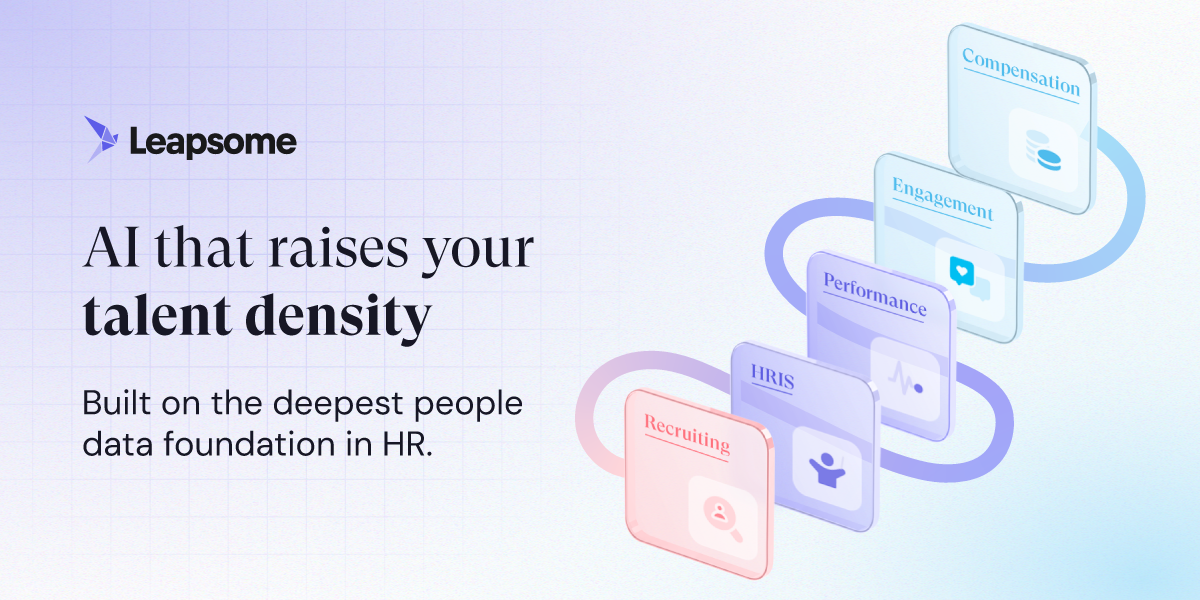
What if AI in HR wasn't just another feature for automating basic admin tasks?
What if an HR platform could connect hiring, performance, and growth on a single data foundation to systematically raise your company’s talent density?
That is what Leapsome is building on the deepest people data foundation in HR.
Instead of juggling disconnected systems where hiring lives in one tool, performance in another, and engagement in a third, Leapsome helps organisations move from fragmented software to a unified talent engine.
Its platform unifies ATS, core HRIS, and a full Talent Suite with cross-functional AI agents, bringing together everything from onboarding and performance reviews to goal tracking, learning, and compensation into one continuous workflow.
Because the future of people operations will not be built on siloed point solutions or manual administrative work. It will be built by HR teams that can connect the entire employee journey, turn deep people data into action, and scale high-performing cultures.
With Leapsome, AI becomes a way to develop more people like your top performers, streamline core operations, and run the HR function of a company twice your size.
[01:00:00:04 - 01:00:02:00]
Joshua, welcome to the show, my friend. How are you?
[01:00:03:05 - 01:00:09:05]
Great, how are you, Chris? Looking sharp today. I would have wore a tie and a suit if I knew he was gonna look that sharp.
[01:00:10:11 - 01:00:13:19]
Well, it's hard to improve on perfection, but I try every day.
[01:00:15:11 - 01:00:21:08]
Are you normally like a suit and shirt guy, or like, is it just because you use a special occasion because of the podcast?
[01:00:22:10 - 01:00:25:21]
I really wanted to impress you and clearly I have.
[01:00:25:21 - 01:00:39:12]
Oh, man. That's good to see you. Before we jump in, tell everyone a bit about your background because you have quite an interesting journey into the role that you're in now. And then we'll jump in.
[01:00:40:20 - 01:01:10:10]
Well, thanks, Chris. And so first of all, just thank you again for being on your podcast. I really appreciate it. And I love talking about some of the work that I've done and the experiences I've had in my roles throughout my career. I started my career as a lawyer. It's my training. I took the typical track of working at law firms and eventually did what most, a lot of lawyers do and went and worked for a corporation.
[01:01:13:04 - 01:01:46:19]
After about eight or nine years, I ended up at my current company, which is called Inifos. It's a specialty food and ingredient manufacturer. I'm sorry, food ingredient manufacturer based mainly in North America. And I've been here for about 15 years. And during that 15 years, I've had some really great experiences working as a cross-functional C-suite executive, which we'll get into a little bit later. But I really think it's a unique track for, especially for a lawyer who,
[01:01:48:03 - 01:02:40:24]
most lawyers are trained to be very siloed and very focused on compliance and focused on legal issues and don't really get the opportunity to really work as a holistic part of the business. And I've really enjoyed that through my career. So right now I'm the chief legal and human resources officer at my company, but I also have responsibility for operational functions like facilities management and regulatory, which is basically making sure all of our ingredients comply with various regulatory FDA, European food regulatory schemes and so forth. And so I've really enjoyed the kind of cross-functional approach where you can pull out some synergies from the functions. And it actually, I think has made me a better executive over the
[01:02:40:24 - 01:02:46:16]
years. Yeah. How did the HR first appear in your career path?
[01:02:48:08 - 01:02:58:15]
Like anything else, we made an executive change, we did a reorg. And I was the guy standing there saying, "Hey, why don't I do this?" Oh, really?
[01:02:58:15 - 01:03:02:08]
Normally it's someone else saying to you, "Why don't you do this?" So you
[01:03:02:08 - 01:03:11:11]
saw this yourself. I think it was kind of mutual, but, a lot of times it's just,
[01:03:12:11 - 01:04:15:12]
if you have that mindset when you're working, I think it's really important for whatever C-suite role you have, if you have a mindset of I'm gonna come in and just solve the problem, then usually you get the opportunity to work on different aspects of the company, right? So this was a classic example of that, where we had a need, I filled it for an interim role and eventually they just gave it to me full-time. And it was one of the best decisions I've ever made in my career. It broadened my depth of the company, it broadened my depth of my professional skills, it gave me a whole new perspective on how to solve problems. And so if you're the type of person who just comes in and says, "I really don't care what my title is, I'm here to help solve the problem that's in front of you," that's how I got the role. So I think the diplomatic way of saying it is it was mutual. I was excited to take on the role, but I think there was also a need and I don't know there was another person really to take it on when I accepted the role. What
[01:04:15:12 - 01:04:19:10]
was your view and opinions on HR going in versus now?
[01:04:21:13 - 01:05:26:05]
I think I had the view that a lot of people have of HR. It's kind of this function that everybody deals with, they all think they know different aspects of it and kind of understand what you do. And when you get in there, I was humbled, especially in the first couple of months of how much I didn't know, how much I didn't realize what they were working on, how hard it is to do some of the tasks that seem very simple to the outside observer. I joke with my HR teams over the years that HR is the only function I've seen in a business where someone will come up to you and say, "If you give someone a raise, then somebody else is gonna wanna raise and you should think about that." Like they know how to do the function. As a legal officer, I never had someone come to me and say, "You know what? I know the law better than you." So I wanted to give you some advice on what the law says, right? I think HR has this dynamic of people, because you're a consumer of its services, that they kind of know how to run
[01:05:26:05 - 01:05:28:04]
the, really,
[01:05:28:04 - 01:05:46:12]
I gained such a tremendous respect for what the HR professionals do as I started managing them, that it is a difficult job, that it does take experience, it does take a special skill set. But it's a skill set that anybody can learn, I think, if you put in the time and the effort.
[01:05:46:12 - 01:05:52:14]
Yeah, because that's something you said before, right? You're like, not everyone can do this. The CHRO role must be learned.
[01:05:54:07 - 01:06:13:13]
What was your approach? Looking back, what would you have done differently maybe? What went well? Like having gone on the journey, and obviously it's a continuing journey, it doesn't end, of course, but having gone through that journey, if you look back, what were some of the things that you did well, maybe some of the things you would have changed, having reflected?
[01:06:14:13 - 01:06:19:02]
Yeah, so I guess let's start with the things I do well, then I'll think about the things I do well.
[01:06:21:10 - 01:07:45:14]
I think that whole, my approach, I think is different than a fair amount of executives, in that I came in there saying two things. One, I said, I looked, talked to my HR team, and I said, I need your expertise, I need your help to help me run this function, I've never done this before. And so I'm gonna rely on you, and I'm gonna empower you to give me your best advice on how to do things, of where are the priorities, where are the actions we should take. And then I told them what I think they were really dying for at the time was I said, once you give me your advice, and once I make a decision for you, it's on me. So I took the burden off of them, where they felt like they were wholly responsible for everything that was happening at the company or anything that was happening with HR, which I think is the most important part of an executive's role is you empower your people, you let them make the decisions, but at the end of the day, you take responsibility for how the function is working. I've seen so many executives do a kind of like a CYA of, well, my person failed me, so now I gotta go get this done, or I gotta go fix this. I told them we're in this together, we're gonna work together, you're gonna give me your advice, I'm gonna make the decision. And then it's on me. And I think that really helped relax everybody and give them kind of a safety net to let them do the work that they really needed to do.
[01:07:45:14 - 01:08:16:14]
Yeah, does there not need to be a balance there though? Like in terms of people owning the outcome? Because I feel like if you take all of that, like you're kind of removing the opportunity for them to fail and push beyond because they know, I don't know, like I feel like when I've empowered people that way, but also had the understanding that they own the outcome, they're actually more motivated sometimes. As long as you create psychological safety and the environment that people feel like they can do that, that's an important distinction.
[01:08:17:18 - 01:08:33:00]
So I'm gonna challenge the presumption of your question initially, because my experience is when you empower them, I don't have to tell them they own the decision. They feel, when the things don't work out, they feel responsible no matter what I say to them. Okay, cool.
[01:08:34:12 - 01:09:23:13]
So, you're right, there are some employees we'll call them CYA employees, right? They wanna just do this and do their work and then have somebody else responsible. And over time, I think you can work through those types of organizational challenges, right? And so that's another great point is no team is perfect, right, there's always someone on your team who's like that, but on the whole, I think if you tell people, I'm gonna empower you to make that decision, I've rarely seen where they say, I've made that decision, my boss backed me up, but I don't feel responsible for it because my boss backed me up, right? I have seen the reverse. Now, there's always an employee who will do that, who'll say, well, I gave advice, but he made the decision.
[01:09:23:13 - 01:09:40:13]
Yeah, yeah, I mean, you just gotta find a balance, right? Like, it can't be, oh, I own, you know, like I'm taking that burden off you, so it doesn't mean the person owns it. I get your point, you're like buying powering them, they automatically are invested in the outcome. Yeah, yeah. They
[01:09:40:13 - 01:09:51:14]
also, I think you build a followership where they don't wanna let you down, right? So they don't want, they, you know, they are so grateful for us putting the,
[01:09:53:01 - 01:10:13:13]
empowering them to make the decision that at the end of the day, they don't wanna let you down and they will fight as hard as they can to make sure it's the right decision. In fact, they're probably more nervous about letting me down and nervous about getting blamed from like the CEO or something like that. They're more interested in making sure that they don't let their boss down, kinda.
[01:10:13:13 - 01:10:21:01]
Yeah, and now that comes with building that trust and that relationship beyond the work, just the work itself, right?
[01:10:22:06 - 01:10:34:19]
As well, so you go, but like I, I think when you do that, people go above and beyond, right, for their colleagues and their team as well. But it takes time to build that as well. And you got to lead with trust.
[01:10:36:02 - 01:11:52:04]
So I think the thing, you know, so now flipping to the things that, where I didn't do as well, is I think I underestimated how long it does take to kind of redo a whole team, right? As much as you wanna get in there and make changes and reset the, things take time, things take, you have to forgive yourself for, you know, if things, you know, if you have some, make some wrong turns initially, right? And so I think my expectation of how quickly we could reorganize and reset the team, I've actually been in this role for nine years now, so almost nine years. And I've actually redone the team a couple of times through the years, some because of people, you know, as time goes on, people transition and they wanna do other things. And then there's other aspects that my company got sold. So I think just being able to be realistic about what you can get done and what you can't get done, you know, it's kind of the classic overachiever problem, like you can't solve everything at once and you have to be happy with the results that you can get initially, while at the same time being very impatient, right? It's that balance you're talking about. One of the other
[01:11:52:04 - 01:11:59:16]
things that you mentioned was about the concept around the dual executive. Yep. Could you talk about that and what that means?
[01:12:01:10 - 01:12:01:16]
So
[01:12:01:16 - 01:12:22:12]
I look at it as an executive who has their specialty and then manages other functions that are not their initial specialty. And my thesis on this is the future of C-level executive roles is not going to be that highly specialized, I only do my silo,
[01:12:23:15 - 01:14:28:21]
you know, responsibilities, right? And so I really, truly believe that whatever that function is, and I, you know, of course there are functions that you need specialized certifications or, you know, for instance, as a lawyer, you have to be a lawyer, right? But that doesn't mean there can't be an executive that manages the legal team, you know, with a bunch of lawyers on it, right? And I think there's, I've seen a lot of structures where the legal team reports to the CFO or reports to even the head of HR in certain aspects, right? And those executives that can come into functions where they don't have the expertise or the, you know, long line of experience can come and learn the role, you know, put in the time and the effort to understand how to pull out synergies between the functions that you manage and can be that dual executive. You will, not only will you save the company money because it's less executives at the top, you don't get bloated with too many executives at the top. But the most surprising thing I've seen in my career is talking to my CEOs, and I've had a couple during my career of, you know, they love just having one less report. I mean, it's the classic, you know, my CEO that I've been working with for a while, why would I want to have two people to talk to about legal and HR? I'll just talk to you, right? And you'll just get it done. I've seen that with the board committees, they love just having one person in the room who knows all the comp, knows all the law and there's all the disclosure requirements. And we just get worked through together with the comp consult, right? As opposed to the CHRO coming in and out of the room, the chief legal officer coming in and out of the room because they can only work on certain aspects of the comp committee's responsibilities. It's very efficient. It's also very, it just makes the executives in your board happier when they have someone they can trust on both functions, right? So I think this dual executive model is going to be more and more prevalent even in larger companies. I think it's going to be there.
[01:14:28:21 - 01:14:34:21]
You said when you mentioned this around skill set over specialization,
[01:14:37:07 - 01:14:39:02]
what does that, what do you mean by that?
[01:14:40:03 - 01:14:41:14]
Well, the classic
[01:14:41:14 - 01:15:40:18]
thing that I've seen, especially, you know, as I've been doing other podcasts and posting on LinkedIn is a lot of people have this, this mindset, if you don't have these specialized skills or you don't have the experience of 30 years and being an HR or 30 years being in law, that you can't bring anything to the table. You don't bring any, you know, any, and my point is there's a skill set. It's, you know, I call it an executive skill set where even if you don't have the specialization, you manage and you're able to pull productivity or pull performance out of those functions by your executive skill set. It's the leadership, it's the management. It's also the, you know, I guess you'd call it intelligence to be able to understand and master the concepts that are part of that function, right? Yeah. Think about it, it's just a mini version of a CEO, right? A CEO is not an expert at every single function of a company. That's a good way of
[01:15:40:18 - 01:15:42:05]
putting it. Right.
[01:15:42:05 - 01:16:03:17]
It's, you know, it's like having a CEO and then four or five mini CEOs below you, right? And it also is good training if you want to be a CEO, right? So having that multi-dimensional, multi-functional experience really makes you a better overall leader that if you want it to be the top role, I think it gives you that skill set. Yeah,
[01:16:03:17 - 01:16:28:17]
and I've seen that. I think if you look at some of the, there's not a huge amount of examples of CH rows that have gone into the CEO role in businesses. One thing you'll see very clearly when you look at their CV is they've worked across multiple parts of the organization and multiple functions, right? In the business so that when they become that CEO, they have a broader view than HR.
[01:16:30:08 - 01:16:36:12]
In fact, some of the most successful CH rows that I know have come within the business, not within HR.
[01:16:38:05 - 01:16:48:16]
Because they bring a different level of perspective and view and commercial acumen across multiple functions to the function.
[01:16:50:02 - 01:17:45:19]
I actually think it's one of the most undervalued part of HR, it sees the entire business. I have not seen a function that maybe it like a chief operating officer, right? And the CEO of course, but I've not seen a function that really sees the entire business. Even I think the CFO role, unless they're really in the weeds of what the business is doing. Right, but HR, we touch on every aspect. I know what functions are doing well. I know what functions are not doing well. I know why they're not doing well. I know sometimes we get even more deeper details. So I know if one of the employees is having issues at home and they were working with them on some EAP or other services, right? I know this is part of the dynamic of why they're performing the way they are. And we try and help them in every aspect that we can.
[01:17:47:07 - 01:19:11:19]
What I found is when I manage HR and know all of what the business is going on. And then I layer on that I have legal expertise. So when people come to me and say, you can't do that because it's not compliant or it is compliant or there's no issue or there is an issue, right? I can speak with authority of, no, you're wrong or no, you're right or yes, you're right. And I add that it's like an extra layer to just managing the function as I've learned my other functions, right? So facilities management where I had absolutely no expertise five, six years ago when I took it over. Now I can bring a certain aspect of like, I know how it is to deal with vendors. I know how it is to try and complete a capital project. Even it's a small capital project, but I've had to do that in my role. I know we've done several CAPEX projects at our headquarters and we've actually moved our Mexican headquarters and I've had to work on that. It doesn't mean I was in every nut and bolt of the CAPEX. And it doesn't mean I was an engineer that could figure out all the risks of the engineering, but I know kind of the structure of how that gets done. And I can speak with authority when I talk about operational issues, right? And it just made me a better leader. It gives you more credibility and it also gives you more empathy for what they're really working on,
[01:19:12:24 - 01:19:20:06]
which is I think the future of how executives need to function in the coming years.
[01:19:20:06 - 01:19:47:24]
What does this mean in the age of AI, right? Because you're talking about like the dual roles, executive dual roles, but now I'm just making this up as we talk. There may be a future where that executive has a team of highly specialized agents that can work with and for them, right? So they don't have to have the deep knowledge
[01:19:49:03 - 01:20:00:10]
on all of these things, right? They have a whole team of agents they can go to if they want specific details. Arnold, how does that shift?
[01:20:00:10 - 01:20:02:23]
I, so I don't think,
[01:20:04:08 - 01:20:41:04]
you couldn't have said it better in my mind. It is the age of AI is actually enabling and increasing the importance of a dual role executive. Some of the things that we call specialized, right? Or skill sets that you need before you can, to the extent that especially some of the mundane tasks of the job of how you just do benefits enrollment and how you do compensation, just basic, having an AI agent or having an AI tool that helps you just get past that kind of basic knowledge or can summarize it or help you learn it more quickly,
[01:20:42:19 - 01:21:31:23]
will give you even more ability to take on more functions, right? So a lot of people have talked about, well, in the age of AI, you need to be more, I disagree, I think in the age of AI, you need to be less, or you have to be, you don't have to be as specialized to enter a new role. You can learn it by having AI assist you and give you the basic tools that you need so then you can do the higher level functioning. I think the question in the age of AI is, as these agents get better and as your employees are working with them more and more, how, as you an executive, do you bring out both the most from the AI agent and from the employee as well and make them feel like they're working together to get to an even better result to a higher productivity? That is a challenge I don't think anybody has an answer to right now. No,
[01:21:31:23 - 01:21:41:11]
we're in the middle of that right now. Like, I feel like we're like, yeah, like I'm already seeing many companies,
[01:21:42:17 - 01:22:03:13]
even in recruiting, look at when they're hiring for a role, whether they're hiring an agent versus an employee, which is kind of crazy when you think about, like, can we outsource this to an agent or do we need to hire someone for this? Those conversations are happening right now and that's kind of wild. Yes,
[01:22:03:13 - 01:23:10:20]
it is wild and I think it's gonna go on for a little while until there comes to what humans can do and what AI agents should do and I truly believe there's gonna be an aspect of both. I think just the definition of what humans do is gonna change, right? So some of these mundane tasks that are been the basis for why you need these siloed org structures is gonna go away and there's a lot of resistance to it right now from a lot of folks who think that you just need 30 years of experience doing benefits enrollment and that's the only way you can do it, right? There's an AI agent that's gonna teach you eventually all the different aspects of enrollment or the policy or some other function, recruiting, right? And then there's gonna be a human that's gonna have to say, okay, now that I know all this, this is what I wanna do. Because that answer of what I wanna do is always changing, right? It's always going to be, you're gonna have the AI agent telling you, giving you all of the probabilities and all of the likely results and all of the things, but at the end of the day, there's gotta be a human directing it in the right direction
[01:23:11:20 - 01:23:22:05]
and there's a unpredictability part of just human activity that an AI agent maybe someday will get there, but it's certainly not there yet. Yeah, you need
[01:23:22:05 - 01:24:10:24]
to, I mean, I think that's an important one, right, distinguishing the difference and ensuring that we still have the human in the loop, right, as well. What does this mean for, I've been speaking to quite a lot of companies recently around like their leadership development programs and like looking at some of the skills and competencies that I like, it's changed so much, right? Some of the things that we're doing right now, I'll be interested to understand for you, what do you believe are gonna be the, let's just call them the superpowers that, the superpowers that executives are gonna need moving forward, the power skills. Let's call them power skills. I like Josh Berson uses that one. What are the power skills that you think every executive is gonna need to be successful?
[01:24:12:02 - 01:26:19:16]
I think number one is executives are gonna have to be nimble, right? This whole siloed, that's part of the dual executive model, right, is your nimble, right? There is very little that you face where you don't say I have to, I'm not gonna be able to switch or tap dance or move around this so I can get the results, right? So it's a focused on results by being nimble, right? I think that's the power skill for the future because AI is always gonna have us on our toes, right? Yeah. AI is always gonna have some new innovation that we're going to have to adapt to. And if you're an executive that can't adapt and can't have a forward-looking approach, then you're not gonna survive in the new world. The other power skill is empathy, I think. I'm amazed how many senior leaders and even just director level or so forth that are not either, I don't know that they don't have it inherently, the empathy but they're kind of trained not to use it, right? And so I think the empathy part, because change is scary, change is disruptive, right? Change and being nimble is, there's a lot of uncertainty there so being empathetic to people's concerns about that uncertainty. And then helping them focus on how do we get through the next day? How do we get through each day afterwards? How do we make them feel good about they have a tunnel or a light at the end of the tunnel as they're trying to solve problems, right? I think that is such a superpower skill that any executive needs. You have to give them that outlook, that hope and be able to do it in a way that's credible, right? Yeah. So the last one I guess is authenticity, right? That's the super skill because in the age of AI, people don't believe half of the stuff because they think it just AI generated. So being able to show that you are authentic and whatever you're communicating is the other super skill.
[01:26:20:21 - 01:26:28:01]
No, I love those. And if I look back and I'm sure you're the same, my development as a leader, none of those were included.
[01:26:30:01 - 01:26:51:20]
(Laughing) And yet we expect our leaders and managers to succeed. We need to help support them, right? In them like, hey, you need to be lead with more empathy. Great, good luck. Like we need to, what does that mean, right? We need to create some support and some guidance to help leaders on the journey.
[01:26:51:20 - 01:27:57:00]
What I've seen, it's been fascinating is in my tenure as a CHRO is a lot of people, I think confuse authenticity with not being empathetic, right? And so they think, well, if I have to be authentic, I'm gonna be, give it to you straight. I'm gonna be direct and I'm gonna be, I'm gonna give you that tough love, right? What they don't get, I think, is there's a way to be authentic and empathetic at the same time, even when you're delivering tough news, even when you're telling someone they're completely wrong, right? It's the way you approach answering that question. I actually think in the manufacturing and the industrial sectors, we actually have a little bit of an advantage in that area. Because if you work day to day with blue collar workers at the plants or folks that work out in the cold or work in the heat and have PPE, protective equipment and go in these dangerous environments, I think you'll see when you go to these plants. And what I've seen is they're very direct with you. They actually don't even see it as being
[01:27:57:00 - 01:27:57:20]
controversial.
[01:27:57:20 - 01:28:21:09]
And they don't think it's personal, right? They'll come up and tell you right away, the company, I'll routinely go in and say, the company let me down on this and I can't believe we're not doing this. And then at the end, they'll tell me how they love working for the company, right? And obviously like, how does this compare, right? They just told me all these horrible things that they don't like. And at the same time, they told me how much they love working at the company. And I think-- Or
[01:28:21:09 - 01:28:29:08]
maybe it's because you create the environment that they can share that, that they have a voice that's heard.
[01:28:29:08 - 01:29:48:16]
I think that's true. Although I don't wanna take too much credit for it because I think that's just a dynamic in any kind of blue collar atmosphere. When you work in areas where there's high safety compliance that you have to be careful of, right? They don't have time to mess around with different words. But at the same time, I agree. The way you manage those employees is your direct right back to them. You explain, I totally hear what you're saying. I don't agree with you and here's why, right? And then at the end of the day, since we don't agree, where can we find something we can do? What are your suggestions, right? Treating them like they're an equal partner with you as opposed to I'm just managing you goes a long way. Even if you have to tell them, I'm just never gonna agree with you. And I have done that, right? And I have done that with certain employees and they tell me flat out I'm wrong and then they'll tell me wrong the next time I'm there and they keep telling me. But they never tell me that I didn't tell them straight, which is the worst thing you can do in those times. And I think if you ask those employees or most of them, they'll say I'm very empathetic, even though I was very direct and told them they were wrong, right? So I think people confuse that skillset a lot.
[01:29:48:16 - 01:29:54:00]
When you, going back to the dual role and I love this gonna take that you have is really interesting.
[01:29:55:16 - 01:31:17:21]
When we first spoke before this podcast recording, it made me think about my own role, right? Cause I'm an entrepreneur. When it was just me and Shane, we both had dual roles, right? There is, I'm managing sales and marketing and content, Shane managing finance, operations, production. We still have elements of that right now. And also an element of why we are successful is that we can make quick decisions, right? Because we don't have to wait for marketing. We don't have to wait for production. And we have teams in each of those areas that the business, right? As well, but it allows us to move an element of speed and agility that allows us to be very competitive and move, fail forward very fast, learn, adapt, evolve, et cetera. But in larger organizations, you've got structure that's been in place for many years and the career ladder and specific roles. Like is there a risk that if you have someone in a dual role that if that person leaves now, now you've got two holes that you've got to fail. Like, does that make sense? Like, cause it's a risk of like you looking after HR and legal, if you leave, they're going to have to find someone that can fill both. And it's going to be difficult to find that in one person. Does that make sense?
[01:31:18:23 - 01:31:26:02]
It makes total sense. And I like to say those are good problems to have, right? You have someone who has done such a great,
[01:31:27:09 - 01:31:50:08]
excuse me, great job filling two roles and running the efficiencies that they're really valuable to the company, right? So that's the first thesis of the dual model, right? You have made yourself even more valuable to the company. The second part is if you are truly a good leader and knowing as a dual role that you have this set up, a good dual role executive
[01:31:51:14 - 01:33:22:01]
develops his team over time, where that if that happens, you have a plan in place for how that would be done, right? So in my case, I have folks right below me who are very skilled in the specific functional area, the legal area, the HR area, the facilities, but they work together all the time, right? So if I left or your dual executive left, the same thesis that was available when I was there is still there for those folks, right? Maybe they could step into the role if I've developed them and they've seen my skillsets and I've trained them on that. And even better, because those teams are working together, which my legal and HR work together all the time, you won't have the problem that I had when I first came in is they didn't have close contact with those other functions and didn't know exactly what they did. My legal team is very knowledgeable about the HR team does and vice versa, right? And so now if you've developed your team below you where they're working together because you're that dual function, you've let them dabble in the other functions as they're working together and you pulled those synergies. There's a natural, probably any one of my team members could take my role. I love that. You know what I'm saying? So it actually, I've improved on that whole model, right? Where I just came in and had to learn the role. They're already learning on the job so that they don't know everything, but they have a much better headstart than I do. Yeah,
[01:33:22:01 - 01:33:34:21]
no, I love that. I just wanted to bring that concern up because I was thinking about it, but it makes sense. But what you're describing though, you have to be intentional about doing, right? It's not just gonna happen itself, right? Because if you're sitting there and you don't have that same,
[01:33:36:00 - 01:33:50:23]
you're not exposing your team to the same ways of working and thinking, then that won't happen. But this sounds like, as you said, the role of the dual role executive is to be intentional about making sure that they have that in place. Well, that's
[01:33:50:23 - 01:34:02:10]
the synergy, right? Yeah. And then also, it helps with engagement too. I can't tell you how many times my legal team is excited about learning about what the HR team is working on. They get such a better view of the business. Yeah, normally
[01:34:02:10 - 01:34:20:24]
they're silos, right? That's a big challenge normally. It's like when I worked in sales, it was always like sales versus marketing. Yes. As opposed to sales and marketing together, right? We weren't working across very collaboratively. But listen, before I let you go, because I can talk to you forever. Sure. Is there anything we missed
[01:34:22:00 - 01:34:23:00]
that you wanted to cover?
[01:34:25:06 - 01:34:25:13]
No,
[01:34:25:13 - 01:34:57:20]
I think the best part about this, as I always say, it's the whole Jerry McGuire line, right? Doing this makes you, it made me a better person overall, and I think a lot of executives miss that in just coming to, they've worked so hard to get to this level, to the C level where you're in charge of it. You have the vice president or the senior vice president or executive vice president role, right? And really embracing that, stepping outside of your comfort zone,
[01:34:59:02 - 01:35:54:13]
challenging your mindsets and being disruptive to yourself personally makes you a better overall on every aspect of the job. And I think what you find over time is it makes you just a better overall person, right? And so how am I able to talk to those blue collar workers when I go to the plant? It's because I had to deal with 40 other tough situations in my role that I never would have had been able to do that as a lawyer for the company, right? And then that gives me the confidence to sit there and say, I don't know exactly how to turn off a 2000 degree furnace, but I can listen to you tell me how to do that. I can be empathetic for all the challenges you have. And I can ask you questions about how is there a better way to do this without feeling like I'm totally not part of the team, right? And I think that that whole aspect is really undervalued in the current mindset.
[01:35:54:13 - 01:36:04:16]
Yeah. Well, listen, I appreciate you coming on the show. I think it's such an interesting lens that you look at this for and so many, I think it's gonna get people thinking. Listening to the show, right?
[01:36:05:19 - 01:36:09:19]
Thank you. And where can people connect with you? If you've done a reach out and say hi, where's the best place?
[01:36:11:02 - 01:36:33:07]
LinkedIn is the best place. I have Josh Hornstein at LinkedIn and that's the best way to reach me. I post very frequently about different topics in my role and I'd love to learn more, especially if there's other cross-functional, I love to hear about other executives you're taking on other roles and things that went well and didn't went well. And so please connect with me there.
[01:36:33:07 - 01:36:45:11]
Amazing. For anyone listening, as always, those links will be in the description wherever you're watching or listening right now. But apart from that, Josh, I appreciate you coming on and I wish you all the best and looking forward to chatting again soon.
[01:36:45:11 - 01:36:47:05]
Thanks so much, Chris. I really appreciate it.


John D. Hadeed, Senior Vice President, People & Culture, US at Primark