
How to Become the HR Leader CEOs Actually Listen To
The CHRO’s real test isn’t getting a seat at the table, it’s whether the CEO would make the decision without them.
In this special episode, Lewis Brown, Jr. - MA and Josh Klein of From Here Collective join Rich Jennings, Executive Advisor to Comcast, to explore what it means for the CHRO to become the CEO’s trusted consigliere.
Using The Godfather as an intentionally provocative analogy, they unpack the skills, behaviours and experiences that make an HR leader genuinely valuable at the highest level. From business fluency and fearlessness to asking better questions, building trust across the organisation and knowing how to influence decisions without needing to dominate the room, the conversation challenges the traditional boundaries of the CHRO role.
For HR leaders, the biggest question is not whether you have a seat at the table. It is whether you are inside the decision-making circle before the decision is made. The episode offers a practical way to assess whether HR is operating as a functional expert, a business partner, or the strategic adviser the CEO cannot afford to make decisions without.
5 things you’ll learn from this episode:
The surprising reason CHROs may have more strategic access than almost any other executive, but still struggle to turn it into influence
The characteristics that can move an HR leader from trusted functional expert to indispensable strategic adviser
Why the strongest CHROs are increasingly expected to understand far more than HR, and what that changes about the role
The tension HR leaders must learn to hold when the CEO, the workforce and the wider business do not all want the same thing
The question that can reveal whether you are truly inside the CEO’s decision-making circle, or simply being informed after the fact
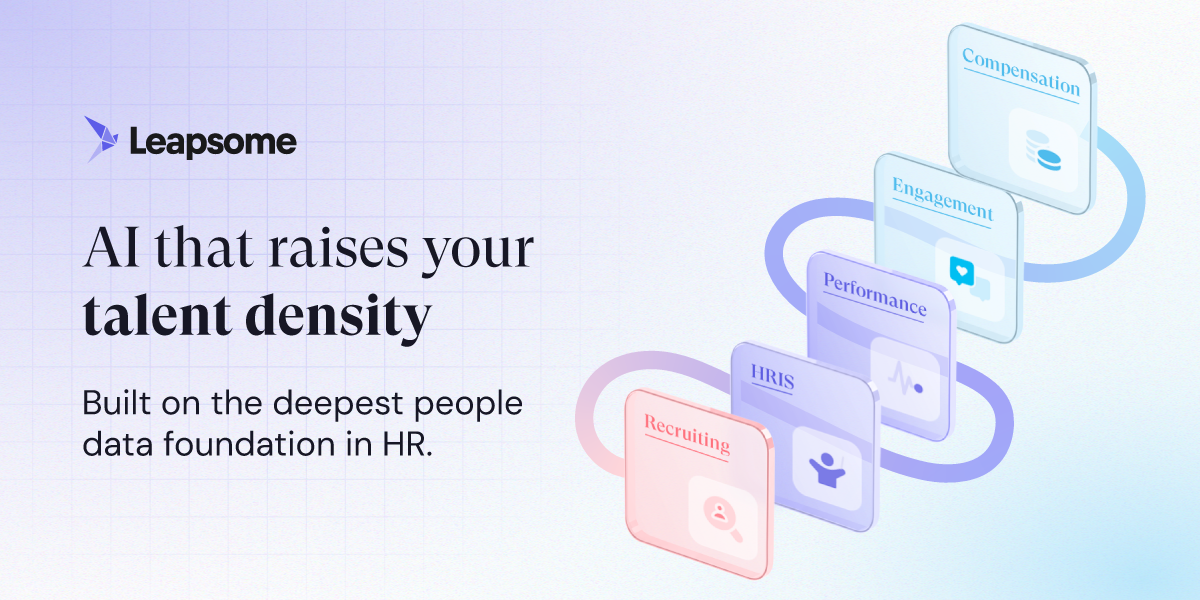
What if AI in HR wasn't just another feature for automating basic admin tasks?
What if an HR platform could connect hiring, performance, and growth on a single data foundation to systematically raise your company’s talent density?
That is what Leapsome is building on the deepest people data foundation in HR.
Instead of juggling disconnected systems where hiring lives in one tool, performance in another, and engagement in a third, Leapsome helps organisations move from fragmented software to a unified talent engine.
Its platform unifies ATS, core HRIS, and a full Talent Suite with cross-functional AI agents, bringing together everything from onboarding and performance reviews to goal tracking, learning, and compensation into one continuous workflow.
Because the future of people operations will not be built on siloed point solutions or manual administrative work. It will be built by HR teams that can connect the entire employee journey, turn deep people data into action, and scale high-performing cultures.
With Leapsome, AI becomes a way to develop more people like your top performers, streamline core operations, and run the HR function of a company twice your size.
[01:00:00:06 - 01:01:28:22]
Hello everyone. Welcome to a special edition of the HR Leaders podcast. I believe this is the first time in one and a half thousand episodes that I have not one, not two, but three guests. They're going to be joining us and boy, am I excited about this. Um, let's, let's just go one by one quick intros. Josh, we're going to pick on you first, my friend. Jump in. Yeah. Josh Klein. Good to be here with everybody today. Yeah. So, uh, been in HR and talent work for a little over 12 years now, started in local government, uh, spend some time in a national nonprofit doing workforce development consulting. And most recently was a Comcast as a director of talent management, um, working with two of the gentlemen who are on the call here today. Um, and right now doing some consulting work with our firm from here collective. Amazing. Uh, over to you, my good friend, Luis. So it's good to be with you, Chris. Um, hello everybody. I'm Louis Brown. And a similar story to Josh privilege to work in a lot of different spaces, uh, nearly 25 years in this work, um, with Comcast and working closely with Josh and so many others prioritizing the future of work. Um, so I'm really intrigued by the discussions that happen here at HR leaders and, and my friends over there in the UK. Amazing. And, uh, last but not least, uh, Rich, over to you, my friend.
[01:01:30:06 - 01:02:17:18]
Well, Chris, thank you for having me. So I'm going to show my age here because, uh, I've been, uh, I've been doing this gig for close to 40 years now, well over 35. Um, but, uh, most recently as with Comcast NBC universal, I was president of one of the operating divisions there. Uh, right now I'm serving as an executive advisor to the executive staff over at Comcast. Yeah. And happy to be here. I'm really excited about it. When, when Lewis reached out with this kind of the conversation that you all have in, I was like, this is interesting. And a take that I've never really heard. And I love the way you were, we're all going to bring this to life and to learn from you. And for everyone listening, it was the idea around the, the C H R O as the consigliere. Now when Lewis first said that, I was like, Lewis, say that again.
[01:02:19:05 - 01:04:08:21]
I was like, I was like, did I hear you correctly? Uh, there. And then from there it kind of brought us all to say, actually, let's get everyone together and have a conversation. Cause I think there were so many unique perspectives and diversity of thought and insights that each of you brought to the table for this conversation. That I thought would be fun for us to all share, share this experience together. Um, but just the level set when, when, when you talk about C H R O as a consigliere, what does that actually mean? Rich, if you could get a sort of ground us in the conversation to start us off. Yeah, of course. So, um, when you didn't go to the term consigliere, usually it's associated with organized crime with the mafia. Um, but it's a, it's an extremely important role within organized crime. And it parallels to what you see in business organizations, that you've got a president or CEO. Uh, so forgive some of the comparisons here, Chris for a moment, but that's, that's the boss. That's the mob boss. Um, then you have, you know, the full array of the folks within the organization, whether it's the mafia or whether it's the business organization, but there is one role. There is one role that sits right alongside the boss that advises watches, predicts, um, provides an element of insight to the boss to run the organization. It's a very powerful position. And so in, in, in my working career, I found this to be a super useful, but that's the origin of the concept. Amazing. And, um, for, for Lewis and Josh, could you walk us through like some of the characteristics, uh, for like we've identified nine characteristics. Can you talk through some of those and obviously we'll touch on those throughout the conversation.
[01:04:10:02 - 01:07:15:20]
Yeah. And let me just quickly react to what you just said, Rich. Um, the first time that Josh and I heard that, that comparator was in a talent management planning discussion with you. Really? Oh, that's great. It was fantastic because we're both lifelong learners and we think learning happens anywhere and everywhere. And so we're, we're not afraid of provocative and intriguing, um, analogies. In fact, I'm a big fan of analysis, analogous examples where you can look at one thing and extract truth for another and one of the places where we think talent and HR has tremendous opportunity. I actually think that's one of the most exciting and, and intriguing spaces to be in right now as it relates to work is in talent and HR just because of where we are with automation and technology and the future of work and all of the things is the ability to see something in a thing that you hadn't seen before. And so talent and HR have tremendous opportunities because we've been asked to behave in a way and do a thing that doesn't necessarily fit where we're going as labor market. And so sometimes it takes, you gotta be provocative and push a little bit to pull more out of us. And so when Rich brought it up in talent planning, Josh and I kind of kicked each other under the table and said, that's really interesting. I haven't heard that before. Um, and Josh texted me a few days later and said, Hey, I've been working on a skills profile. What would it look like if a CHRO was actually a consigliere and rewatched the Godfather and pulled up Tom Hagan and, and we built a rudimentary skills profile, uh, on that consigliere. But then we, you know, I pulled you to the side rich at a conference and showed it to you and then you over conversation have really honed in on nine specific attributes and that and I'll just quickly give, you know, the, the title for each. And then, you know, we can all unpack together, but steady and calm. Before you go, Lewis, let me just say in that meeting, that was probably the first time ever I had talked about the concept out in, in public. Usually it was when I was recruiting or hiring or just placing a CHRO in my organization that would report to me that I would, I would talk about it. Um, so it was probably when you were newer in the organization, but it was a way for me to kind of accelerate a path that I thought was going to be important and you and Josh look like, you know, you all could be henchmen or something made men. So it seemed appropriate. We'd go ahead. Yeah. So the first one, go ahead, Chris. No, I was going to say for the sake of the listeners, we'll insert that clip right here.
[01:07:17:17 - 01:07:18:09]
And now we're back.
[01:07:21:11 - 01:08:24:05]
Okay. Carry on. That's fantastic. And, and you know, just like Michael took the time to explain to Kate, uh, what Tom's role is and his importance to the family, it almost went without saying for everyone else who was there. They knew because of the way that Tom shows up, but Rich, you first, you know, I'll give the first three, Josh, and then you hop in. Um, the first is steady and calm. And, and you know, you saw it in the clip and for those of us who are familiar with the, with the, the, the Godfather movies, Thomas steady and calm. He, he is, he does not escalate. He, your urgency does not become his emergency. Um, he knows how to move outside of anxiety. He is observant and he sees the bigger picture and he's able to synthesize thought and tie pieces together while respecting the proper level of emotion.
[01:08:25:07 - 01:08:42:24]
He's also charismatic and convincing. He's not too loud. He's, he's compelling and he knows when to raise the temperature versus decrease the temperature specifically, uh, in relationship to his executive partners.
[01:08:46:12 - 01:12:21:17]
Yeah. Absolutely. Yeah. Yeah. That, yeah. It's a, it's a, it's a great, those are a great three foundational ones to start. And you know, I think Tom, you know, he does a really good job, um, balancing the patience, uh, with the urgency that he has to get things done. Uh, he holds his confidence, um, and he's earned that confidence through a lot of trials and tribulations. Um, you can tell when he speaks, people listen, and there's a reason for that. He's proven himself time and time again. And when I was watching the film back, I was really paying attention to all the inputs that Tom was gathering, what he was bringing and then how that turned into outputs that were strategic when he brought those back to veto. And it even made me think of Tom in 2026, like what is this guy like now if he's got like a few AI agents or something, working on his behalf, doing some of this information gathering, and he can focus on some of these skills that we're talking about here that are much more human that are not going to be easily automated. And I think it also says something too for, uh, the way HR roles moving into the future can, you know, uh, ensure that AI is serving as an accelerant as opposed to, uh, taking, taking, uh, the human work away from them. Um, so I think it's, it's a really unique spot. Uh, the other things we had written down was, you know, that he's tempered and balanced, he's prophetic and he's truly fearless, um, in his work. And the other thing I wanted to call out quickly, um, was something that Rich has also said in talent conversations before that really hit home was he likes it when people are good question askers and they ask the right questions and that the questions have a strategy behind them. And if you look at Tom throughout the film, uh, both the films, um, he does a really nice job of asking questions, um, strategically to get to where he wants to be. Uh, so yeah, those are, those are some of the characteristics that really stood out to us as we watched it back. Yeah. And I would, I would say, I was at Chris, it's probably important for your audience to note here that, you know, this doesn't necessarily supplant. So in the movie, Tom by trade was a lawyer, uh, in just the trade factor was pretty important to the role that he carried. So, so my point is, you know, things like being conversant with labor law practice or with recruiting or talent, all of those things are still important. Um, and they need to exist somewhere within the organization, but those are skills you can hire those skillsets. We're talking here in the Konecillary about a home to skill set. Um, so just setting a foundation that this doesn't say you throw everything out of the window, but this is how you embellish, this is how you, um, serve the organization in a way that perhaps the traditional path of serving, uh, it is not provided by being able to get and hold the ear, not only of the CEO, but of the other lieutenants within the organization. Yeah. Wow. So much that I'm back. I was just laughing. I was laughing in my head, by the way, the idea of the made agent. What does it take to be the made like, what's that? That's actually a demonstration of Tom's thinking, because at no point did we know who worked for Tom, right? In, in the room,
[01:12:23:19 - 01:12:43:05]
who we knew worked for other people within the family. Not, not at any point did we know who made up Tom's organization. And so he clearly though, because of the Intel, his knowledge of the business, his knowledge of their competitors, he clearly had antennas on the streets,
[01:12:44:05 - 01:12:46:14]
whether those were people or agents,
[01:12:48:04 - 01:14:02:21]
we don't know what we don't need to know. And I think the CHRO of the future is the same. Is it, is it coming from a person or a bot? It doesn't matter. Is it right? And is it relevant is really the question. Yeah. I love that. And one of the, one of the first things that came to my mind when I heard the concept was, you know, a lot of companies have a chief of staff or they have a general counsel or they have maybe a CFO who they rely on to do some of these things. So I'd be curious like to put it out to the group, why HR? And what are the unique qualities and experiences that HR folks would bring to this conversation to make this, you know, a uniquely a role that we think is really well suited for a CHRO? Yeah. Let me, let me jump in on that one, Josh, immediately. It's access. It is access. There are two roles in an organization and I'll speak specifically to mine as the division president. But this is probably true of most, most organizations, business organizations, the CFO has a lot of access. If the organization has a COO, it might be similar, but typically it'll befall a CFO.
[01:14:04:01 - 01:16:08:18]
But I would argue that the CHRO has a level of depth and access to the business. The challenge is many times the CHRO does not tap into it, but they have the full field in front of them to go run if they run it. So to me, that is, that is the biggest reason why when we talk about this, this is a role that can go places within a business that almost no one else can that can provide insights back to the leader that almost no one else can, can provide insights to the lieutenants within the organization like no one else can. It's a, it's a level of depth that in my opinion exists solely within this organization. It's a CHRO role. CFO can go deep on finance and operations. But when you start talking about how do you match talent skill sets, how do you look around corners? Those are some of the things that get into a depth that's reserved for the CHRO. I love, I love that you made that point. And honestly is the reason I started this company because when in my young career, I worked for a conference business and I looked after, you know, content and events across every industry vertical. I was speaking to chief supply chain officers, chief cybersecurity officers, and people like, why did you choose HR Chris? Like of all the things that you could have chose. And what I realized during the thousands of those conversations, Rich is that HR and the CHRO were the only ones that touched every aspect and every element and every part of the business. And that fascinated me. And this is 20 years ago. We were and HR looked very different, but even then I could see that it was very unique. And I think the reason I could see that is that I was speaking with the other decision makers and the board members and they didn't have that access. I was like, this is incredible, but HR really wasn't to your point. They weren't really ready. They didn't really, they didn't utilize it and tap into it. Why do you think whenever there's a huge change or transformation, everyone turns to HR?
[01:16:10:02 - 01:16:32:11]
What happened during the pandemic? Everyone turns to HR was like, how do we, how do we lead through this? What's happening now with AI? People actually, which I never thought I'd ever say, turning to HR to be like, cause they can access and pull the right people together and write parts of the business to lead through constant change and transformation as well. So I love that point. Do you just made?
[01:16:33:24 - 01:16:38:01]
Yeah. That's fantastic. Yeah. It's, it's true.
[01:16:39:06 - 01:16:44:07]
And I would also add for the leader, for the boss, for the CEO,
[01:16:46:06 - 01:16:51:16]
every CEO is going to be looking for what I just described.
[01:16:52:22 - 01:16:55:16]
It's easily placed within the CHRO function.
[01:16:56:17 - 01:17:06:24]
But if the CHRO is not delivering it, I guarantee you, I guarantee you that she or he will find it somewhere in the organization.
[01:17:08:09 - 01:18:50:10]
And the, really the big deal is to make sure that if you are the CHRO, if you are that made woman or made man that has that level of access that you understand that you realize it and you utilize it in a fashion that serves the interest of the organization, but certainly the boss, the CEO. Yeah. You know, Rich, I want to just piggyback really quickly on the concept of access because I think it's really astute that the CHRO has access throughout the organization. Everything requires a people-based strategy. And even now, when we're seeing agents, automation, and technology pop up, there's a closer connection between HR and IT. And sometimes we make the mistake of personifying AI, right? We give it a name and we compare it to the people in the organization. Josh and I see it as a partner, but not a replacement for people, but it still sits within the HR, right? It still sits within the HR roadmap because we have to treat it like an agent of the company and all of the things that are applicable in HR apply so relevant, you know, in a relevant way to the technology that we're, we're engaging with as well. And so access is, is that across the, the org, but I think CHROs also have unique access to the hearts and minds of the workforce. And I feel like Michael and Vito leaned on Tom quite a bit throughout, cause we only talk about the first two movies, right? We're not, we don't really talk about that. We need to love a couple of podcasts.
[01:18:52:24 - 01:19:46:23]
But they leaned on Tom for also what was happening in the hearts and the minds of the family and some of the decisions that they were going to make, how that would impact the family in, in a really, really interesting way. So that access, I think is double-sided, Rich. I think it's access up into and through the org, but it's also deep into people that we need to make sure continues to be prioritized as we talk about technology. Yeah. And let me, let me give you one other point. That's extremely critical here in the Konsigli area. And this was illustrated in, in, you know, the theme of the Godfather, but it's the access, but it's leveraging the access to understand the depth of the organization. What makes the organization tick? What are the things that the organization needs to do? And I, in my career,
[01:19:48:16 - 01:24:23:15]
I knew I did not have a Konsigliari CHRO, if the individual sitting in that seat failed to understand, how the business was working, how it worked and what our objectives were, because that's foundational. If they don't understand that, then it's hard to manipulate the talent to get the organization to where it's, it needs to go. It's hard to set up an organizational structure that supports the future of the organization, if you don't understand it. And that was in any, any CHRO that kind of said, I'm going to stay in my lane, and I'm going to advise you on labor law. I'm going to advise you on talent. I'm going to, if they didn't understand the elements of the business, that was a problem. And Tom clearly understood the mission. Tom clearly understood that Bido didn't want to get into the drug racket, let's say, because that was kind of what was at play that he was going to be advising on. So he knew what was in the organization. He knew what was important to the boss or the CEO, and he knew the talent, not only within their family, but within all five families in New York. So if anybody out there, Chris, and you're listening audience, hasn't watched Godfather, I'm sure they're going to go run back and go watch the old movie now, but it'll truly be telling. Yeah. After our last conversation, I dug out my Godfather box set from in my garage somewhere as well. One of the things that we didn't touch upon though, that there is tension, right? In this role. So I love the analogy of protecting the family law is a currency, but the search row sits in an interesting place between the CEO's agenda, the employee base, the labor market, the board, right? So there is, there is, there is tension right in, in there. And law is not to any one of them. It's to what the family needs. Right. So how does HRE does navigate that tension? Does that make sense? I hope that makes sense. Yeah, it does for sure. And one of the characteristics, that ninth one, this notion of truly fearless and being witnessed by other, this, this fearlessness is a bit of what allows that individual to hold the tension. It is, if you read through the definitions of what we're us on in this conversation is looking at on the page, it's not self-diagnosed. It's endorsed by third parties whose opinion the CEO trusts. And if you have to claim it, it's, it's almost like Chris, when people say, yeah, I don't talk a lot, then you know, that yeah, they actually talk a lot. So if you have to claim it and say, yeah, I'm fearless, then that probably means that you're not, you need to go have it gut checked. Does that mean, sorry to interrupt you. Does that mean that when people say I'm a HR business partner, it's not, cause you never hear, you know, cause you never hear marketing say, I'm a marketing business partner. I'm a sales business partner. I can keep going. Right. Sorry. Just for it. Yeah. That's spot on. So, so it's not self-diagnosis a point there, but to your point, Chris, you need an element of fearlessness in order to be able to hold attention, because as an individual, you need to feel that there's some backstop or some release valve of the pressure. You're not worried about being fired. You're not worried about retribution. You're not worried about your, what your peer is going to say. So there's gotta be something. In the mafia context, a made man, because it gives you certain allowances, certain privileges, certain certainty, certain levels of just assumed trust with the boss and with the organization. And that promotes, in my opinion, this notion of fearlessness because you need to be able to hold attention. You need to be able to push back. You need to be able to pull folks together. So that that's a great, great point. And if you can't sit with it, if you don't like conflict, if you don't like pressure, then there's probably two jobs you don't want. You don't want to be working on Wall Street as a hedge fund manager. And you probably don't want this role as a consigliere. Yeah. I'm sorry. Go ahead, Josh. No, I was just going to ask too, does anybody have any recollection of like a time when you've seen that happen and been like, Oh, that person is fearless. Like that leader is fearless in this moment right now. And had that thought run through your mind. Cause I was thinking, I have a couple, but I'd like to hear what you all have.
[01:24:25:06 - 01:25:21:20]
Well, I actually was going to go back to the movie and it's a really important question. Josh, you just asked, I think Tom actually demonstrates that extremely well. If you think about the personas across the movie, he was probably the most gentle, the most soft-spoken, but he carried referential power. He earned it and he didn't have to say a word to do it. And in the corporate space, sometimes we have elevated the loudest voices in the room, the people who know how to bang the table, the hardest. But the reality is Tom could walk into a room, set his notebook down and cross his legs and not say a word. And the reason why we knew he was fearless is because he didn't have to say a word. And so I think about what fearless looks like. How do you demonstrate fearlessness? And sometimes we, we flip it the other direction.
[01:25:23:23 - 01:26:17:22]
I think when Tom, people listen, people listen throughout the entire film every time he speaks. And there's a reason for that. Again, he's, he's paid his dues. He's, he's, and he can be fearless because he's, he's confident in his knowledge and his skills. And, and the work that he's done to get him to the point that he's at, that he doesn't have to yell to make a point. He can sit back and wait for the right moment and inserted strategically. And he's thinking about ways to win and win and how to insert those points. It's going to move the other people in the room. And you can see it in multiple scenes throughout the film. Yeah. I think like one of the things I've learned just personally is you can do many of that unless you're willing to take risks and fail forward. Right. Like earlier in my career, I try to play it safe. I didn't really get far.
[01:26:19:03 - 01:28:13:08]
And then only when I started taking risks and not asking for permission and just trying things like in my earlier days, whether it's like as a sales rep, I was tired of waiting months to get paid my commission because we did invoicing. So I worked with IT to build a payment gateway so I could get paid quickly. And I was like 18 years old and I was one of hundreds of people and I got in a lot of trouble. But by my director saying, how dare you go above my head? And I was like, now you also get paid early. And he's like, oh, thank you, Chris. That was amazing. Right. But wrist my neck on the on the shopping block. And by the way, 20 people lost their jobs in payroll because no one left. No one needed to chase invoices anymore because we bought a payment gateway. Right. Like in many of those versions. So like I've learned that you can't you have like and that's why they can sit there. And they command that respect because people know they've kind of gone through those moments. Right. And by the way, I can't share stories. I forget in trouble with a lot of the see it rose, but I can tell you I've seen many incredible see it rose walk away from the business and stand like like they stand on business like they're like literally and they eat and those and those amazing leaders find a job just as quick as well. I know we're very well respected in high regard because they're willing to walk away. Even when I've even when I've heard him and like that's insane that you're going to do that. But you know, and when those leaders do find the right organization and the right CEO, magic happens. Right. Where does come together? Well, let me just say something that kind of ties through what would each of you said in the conversation. I would put out there that fearlessness in Josh, I could I could sound, you know, cite numerous examples, but fearlessness comes from deep understanding or deep ignorance.
[01:28:14:11 - 01:28:22:14]
So, Chris, in your story where you were young and your it's it's like a child. A child is a great example. Yeah.
[01:28:23:16 - 01:30:38:17]
It was that it was that 100 percent. It was 100 percent. But later in my career, later in my career wasn't it was that I knew I generated, you know, 17 million plus a year for the business and you could not get rid of me anyway. Like I got to a point where I was like earlier it was ignorant. It's 100 percent. I was like, you know, I could have got fired. And later in my career, I was like, I've been here for 10 years. I've earned it. I'm generating a certain amount of money a year that I'm kind of untouchable. And I leverage that to move mountains strategically. And that's the deep understanding. And that's where in this role you want to move away from your fearlessness coming out of deep ignorance. But it comes from a deep understanding because that's really what's going to get you the respect and the admiration of your peers that will get people to open up. Because as soon as the head of marketing or the head of finance or the head of service or operations feels that you have a deep understanding of their business and their operation, then when you make comments or suggestions or try that, that you can do it fearlessly because if someone challenges you like, Chris, to your point, somebody could challenge you and you say, no, dude, look here. I'm bringing this level of coin to the table. Let me tell you how and why. And you could back it up where we trip over ourselves, particularly in the CHRO role is if. And I would say even in the CEO role is if your fearlessness comes out of ignorance. And I think it's very important to identify those places because they can't coexist. You want to make sure that the balance always sits on the side of understanding versus the ignorance. Yeah, it's a it's a great point. And thinking about it developmentally rich and has people are moving up through an organization or through a company. What can some folks be doing? Because I know some of the listeners today probably aren't all CHROs, but if I'm a director and HR manager in HR right now, what are some of the things I can be doing to be sure that when I get to that point, my fearlessness isn't from ignorance, but it's from actually actually having that knowledge and having the reps in my pocket.
[01:30:40:00 - 01:31:39:17]
Yeah, this is so let me jump in here first and y'all can come in, but be a student of the business. And what I would coach folks in that says not the CHRO, but some of the folks that sat lower in the organization that were expiring aspiring to get there show up in unlikely places. So a lot of times the HR leader shows up for the HR meetings or if there's a union conversation or they show up for the talent meetings, but they don't show up for the P&L, the forecast meeting, the budget planning sessions, the operation meetings. Show up in those meetings because that will demonstrate that you are a student of the business, that you have care and skin of the game and insight. And you're going to grow and you're going to learn and just that information alone will help inform how you apply your fundamental HR skills so that they are a beneficiary to the business. I love that, Rich. And I think I would just add, what are you reading?
[01:31:40:19 - 01:34:21:06]
I remember my first few times at Comcast when we got invitations to an opportunity to listen to the playback of our market report in HR. And when I showed up, our HR leader had already listened to the playback. He had read the report. He knew what our competitors are doing. And he knew what our market share was front to back. And it reminds me of a scene in Godfather One when Tom was talking with Vito and with Sunny about what they should do next. Should they go into this new phase of business and compete with others? And Tom in 30 seconds, he essentially laid out the family's organizational strategy and said, we exist to do one, two and three. Here are the risks if we do four, five and six. And here are the benefits if we do seven, eight, nine. And here's my recommendation. And he sounded like an obsolete or he didn't sound like a lawyer. He didn't sound like anything. He sounded like he ran the family because he knew the business better than others. And so I challenged myself, even in my roles and functions. Am I reading the information that would inform me on the organizational strategy, not just mine, but to your earlier point, the other five families, like their strategy, their market share, what makes them unique? And am I able to translate that and speak to that real time? Yeah, I'd even I've even had Lewis to look beyond your own industry. Like a lot of what I do is actually I mean, of course, I have to have that as the foundation. Right. But for me, most of my my reading and education now is be out completely outside of the domain of HR leaders and looking in different different other industries and verticals and technologies that have nothing to do with our business and some of our biggest innovation and breakthrough by reading things that are all none of the things that pop up when you hit when you hit the Google search for HR resources, etc. And what I found actually interviewing HR leaders, I typically ask a question, what are you reading? Like, and what are some and it's never the stuff you expect. Right. It's outside of the remake of the traditional part from my podcast, everyone keep this in place outside of that. Traditionally, it's not right as well. One thing I do want to touch on is point, though, we spoke a lot about the CIT row. But what does the CEO have to do to enable this relationship? We don't talk about that enough. And and having worked side by side rich for CEOs to hire HR rows, what is their role in this?
[01:34:22:23 - 01:34:27:05]
Yeah, well, I you know, let me let me talk about the easy path first.
[01:34:28:23 - 01:34:51:22]
But as a CEO now, they may or may not call it constiglieri. But to my earlier point, a CEO is always going to look for work and they get insights into the organization. And if we're lucky that that CEO or president or leader will have some familiarity with this concept and they will bring the design to the organization.
[01:34:53:12 - 01:35:57:24]
Now, maybe they want their constiglieri to be the CFO. I would argue it better sits in the CHRO space. But that that's the ideal. If the CEO recognizes, yes. Now, on the conscious level, they may do it and they may be explicit about it. So to Lewis's point in a meeting, I probably blurted out, yeah, we need we need to get this constiglieri concept out there. Or it may be on the subconscious level where the CEO doesn't really even articulate the concept. But I get I guarantee you, she is looking for or he is looking for that source of information that can help him or her inform be informed and make decisions. The other path, which is not quite as easy, is if you have a CHRO. So let's just think in the context of talking about the Godfather series. If if Tom and I think I'm trying to remember the movie, the movie Lewis and Josh here, but I think there's one time where there was some chatter about, you know, could Tom could one of the other families take Tom?
[01:35:58:24 - 01:36:53:03]
And so so the other path is that you've got a great constiglieri. That constiglieri has worked for other families. They understand the role and they're good at it. And so even if the boss doesn't understand their worth or their value, it will be demonstrated. If you pluck Tom out of the Corleone family and moved him to the next, they would quickly start to understand the value of the work. It would seep into the CEO, it would seep into the boss and they are now designing and building that into the fabric of the organization. So two ways to get there. There are two paths. But it's important in my mind that the constiglieri understands the significance, whether the boss invites her in or him in or they have to open the door and invite themselves in.
[01:36:55:05 - 01:36:55:12]
And.
[01:36:56:12 - 01:36:59:00]
That's fantastic. That's a mic drop, Rich.
[01:37:01:04 - 01:37:11:01]
You all had me disconnect my mic, so I probably could drop the mic. Yeah, we should just get in the future. We'll just get you a second mic just so you can drop it.
[01:37:12:13 - 01:37:21:14]
On that point, you said at the end of that sentence, whether they are invited or they just take a seat at the table, whoever you said it.
[01:37:22:16 - 01:37:26:09]
Again, this is the only function we have that conversation around.
[01:37:28:01 - 01:39:13:22]
Even the other day, you know, Josh Burson did a post around this, you know, what is the role of HR and their value? Like, why are we still having this conversation? I've been doing this since I was 17 years old. I'm 38 now. And every year, this conversation of HR seat at the table still keeps coming up over and over and over again. We're seeing a huge amount of CHROs being hired from outside of HR into the CHRO seat more than I've ever seen. And I feel like year on year, I don't have the data for this, but just for my hundreds of conversations I'm having every single month, I'm seeing this happen more and more and more. What's driving this, in your opinions? If you don't mind, Rich, really quickly, I think some of it is tied to what you just said, is the CEO was looking for leaders, looking for the referential leader, the influencer in the organization, the whisperer. They're looking for the consigliere and they're saying, where do they exist? If they're in sales, fine. Yeah. Where I need them to be. I'm going to place the persona in the profile so I can get the results that I want. If they're in finance, fine. Place the persona in the profile so I can get the results that I want. Whereas historically, we have continued to say in order to be in a specific domain, you have to have worked in that domain your entire career. Now it's about outcomes. It's about the what and the how. And I think that translates beyond HR, but we're seeing it show up in HR or HR are expected to be business leaders, not business partners. Right. Yeah. That's exactly right. Sorry. Go ahead, Josh.
[01:39:14:23 - 01:40:22:05]
No, I was just going to quickly say that just, just readiness for this type, this level of HR role, I think could really be heightened and benefited by taking some time in the business and figuring out ways to get our HR folks actually embedded in the outside of the business for 18 months, 24 months, and let them come back and then see what kind of perspectives they bring. And how they approach some of these problems because I would venture to say and based on experience of seeing some folks who've done this. I think it'll be quite different. And I think it'll get a little bit closer to this concept that we're trying to get to here. Yeah, and what I was going to offer is, Chris, to your question, why would a CEO do that? Why would they go and look at to play someone in the CH role that might be pretty thin on kind of the traditional things that you would expect to see HR to do? One, those things are going to exist at some level within the HR organization. So this is a skill set again that you can hire for. What they're looking for is that skill set that needs to be honed. And if you have a CHRO who is doing it well, my opinion,
[01:40:23:21 - 01:41:00:23]
they could also run parts of the business. And so now you have a utility player on the field. So when I think in my past history of CHRO's or HR leaders that work in my organization. And even in fairly recent times, I started giving them more responsibility in the business. I started putting things a junk to HR for them to run and manage. And so to your question, why would a CEO look for it? The CEO wants someone running in parallel with her or him that understands the depth and the nature of the business.
[01:41:02:02 - 01:42:31:16]
But then also has a team behind them that can help them place that depth and knowledge and intelligence rightly within the organization. So to me, it just makes sense. You want to have that person running point in parallel. And in Lewis and the team I worked with me for a few years. We are probably one of the other things you heard me say a lot was utility player when we would look to manage talent. And so the CHRO coming out of that traditional set on start getting other skills because baby, if you on that field and you can run and you can jump and you can catch and you can scramble and you can block and you can tackle. That's going to make you a utility player. But if all you can do is just pass the ball and run fast, you're going to kind of be limited to your lane. And CEOs nowadays, I think, are looking for utility players in that space. Yeah. And the CHRO has really set the tone for that, right? Like when the CHRO is exemplifying those things, it trickles down throughout the HR organization. And we saw that happen firsthand at Comcast and we were beginning to be more knowledgeable of the business and to get out there in the field more and try to better understand what was happening because we saw the leaders actually doing that. So I think that that's another way to continue to develop those skills throughout the organization is just leading by example for some of these folks in leadership positions.
[01:42:32:20 - 01:42:56:01]
Yeah. People always ask me like, "Kakashina, you've interviewed thousands of HR leaders over the years, like over 20 years. What's some common characteristics that you see of a highly successful CHRO?" And that's the number one thing that comes to mind is the people I see that are now CEOs, you know, think about people like Lina Nair, CEO of Chanel, former CHRO of Unilever.
[01:42:57:03 - 01:43:44:11]
They have experience working across every part of the business. They spend years outside of the HR function working operations, sales across different parts of the world, right? They have the cultural nuance. They've been working across different demographics, right? And one of the things I realized is they've also been intentional about doing that. Like it wasn't an accident. They kind of understood for them to be able to kind of be the best CHRO or be the best consigliere that they need to be able to not just understand the business on paper, but live, breathe, operate, be in that. And when they then become the CHRO, it's just different. Like they just have a different perspective. And also they carry a different level of respect like we mentioned earlier, because they've done it. You can't bullshit them.
[01:43:45:15 - 01:45:01:20]
It's like, "I've been on the ground. I know." The same with me. Like in this team, everyone in the HR leaders knows I've done every single role in this company. Like I've done speaker acquisition. I've edited 100 podcasts. I've done all of those. I've sold, right? So when they come to me and say, you know, XYZ, I'm like, "Okay, I kind of know." You know, in the same way when they're walking in your room, they have that credibility. They don't need to prove themselves. They already have done that. So I love this point. And for those, the RCHROs coming in, you said it perfectly rich. They're already surrounded by that technical expertise. That's not why they're being brought in, right? To know the specifics of how to run payroll. Like that's not why they're there, right? They're there to lead the team that already has that already. And I'm seeing many of them do an incredible job, actually. It's been really refreshing to see that play out as well. What are we missing? What haven't we discussed that we should have? Like we've gone like, I mean, like, I love this conversation. What have we not spoken about, guys, that we really should have? What you raised a point earlier, Chris, about loyalty that I think is worthy of a double back.
[01:45:03:20 - 01:45:10:12]
This kind of a concept, the parallel that we're drawing between the family and the organization,
[01:45:11:14 - 01:45:40:18]
probably gives people the little bit of heartburn to say, well, what does loyalty actually look like? And I know people in HR and talent, in the midst of the re imagination of the workforce, and so many of the things that are at play right now, are wrestling with really difficult decisions that have to be made about reaching an organization and companies who are kind of redefining themselves right now and saying, this is who we are, this is what we're going after. And what does that mean for people teams?
[01:45:42:12 - 01:46:07:13]
Dessertment is so important in this discussion, your ability to discern and to communicate what you discern, because blind loyalty is going to get you in a lot of trouble, right? Loyalty to the to the CEO, one of the things rich that you said, early on in this discussion is my conciglier has permission to tell me I'm wrong. They just better be right.
[01:46:08:23 - 01:46:56:17]
Better be right that I'm wrong, right? And so you don't want blind loyalty to you. You don't want blind loyalty to the organizational strategy, but you also don't have a lot of space for loyalty to the workforce that doesn't allow the organization to make the decisions that may need to be made. The question that I've observed you ask is how can you help me discern to make the right decisions that need to be made that produce loyalty to the outcomes that we all are seeking, even if it's painful in the moment. And so it's hard to answer the question with a straightforward answer. This is exactly what loyalty looks like. I think loyalty requires understanding and discernment.
[01:46:57:22 - 01:48:07:17]
Yeah, well, I would say I think that's that's exactly right. Well, the loyalty piece of this is it's multi directional. So it's not just loyalty to an organization or loyalty to the CEO. But the other lieutenants in the organization and the layers of the organization needs to feel that this position is also loyal to them. Because without that loyalty, there is no confidence. So if I don't feel that you as the conciglieri are loyal to me and understand my business, I'm not going to give you information. And so You know, the right part of this role is extraction of information, the utility of information, but the ability to gain the trust and the loyalty of the organization at all levels from the CEO down to the front line. So that you can keep every door and every channel open. That's the only way is a CEO or is the president in my role. I couldn't be in all aspects of the organization. I needed to have good ground intelligence as to what was happening. Now, for those who work with me know, I would spend a lot of time at the front line up. Some of the folks, Chris, you don't know this about me. But I could jerk chicken.
[01:48:09:00 - 01:48:36:12]
And I would say pretty damn good jerk chicken. If you're not familiar, it comes out of the island. Bro, don't tell me that Louis Louis already knows that my wife's Jamaican. So I'm locked in about I'm more of a curry goat guy. I'm just saying, you know, I like that's that's like when I go to when I go over on a Sunday that was the Uncle Michael best curry goat shout out to you. That's what I'm worried about.
[01:48:37:24 - 01:50:00:06]
Anyway, sorry, sorry. Yeah, that was a good point. But the point is that all started early in my career as a way to sit down with technicians and talk about what they were seeing and what was what was happening in a part of the organization. By cooking for them. So anyway, my point to sum it up is that loyalties exist on multi planes and multi dimensions. And so don't make a mistake if you're the CHRO of thinking that your loyalty exists only to the CEO. Your loyalties have to exist throughout the organization because it's going to be critical for you to move in spaces through the organization. And I'll say in the other part, it's important because visually, this is going to be off putting when the HR leader walks into a budget planning meeting. Why, why is why is she here? Why is he here? You want to get into a space where that is not a visual off putting site is more so an expectation. Almost to the point that the meeting doesn't start if you don't have the CHRO in the room, because the the the value of what that person brings into the room or the conversation or the provocative questions that will be asked is undisputable. So, yeah, just remember those loyalties was to your point there on multi planes, multi dimensions. And if you're good, you're going to hold all of those spaces well.
[01:50:01:21 - 01:53:52:05]
Josh, I love to you to talk about which I think we didn't cover is some of the habits that you did. We recognize and one of the ones that really stood out to me and and I love you to talk about a bit more about these Josh after is the one that talks about executes lost arguments without residue. And I don't know who wrote that, but I just love the way it's framed. And then we talk about it as like, you know, when the decision goes the other way, you carry nothing into the next conversation. And I would say personally, you know, people always ask me about, like, how do you work with your best friend, Shane, for 20 years? That's that's how. Because we can go into a conversation, completely disagree and completely go back and forth and come out of it 10 times stronger and carry no resentment into the next conversation. And that is tough to do. I like that is really tough to do. And it's because we understand that whatever I'm saying, whatever Shane saying is that he wants the best for me and he wants the best for the business. And that's it. Sorry, I just want to say personally, that one really spoke to me, but I'd love to talk about some of the other ones as well. Yeah, yeah, me as well on that one, Chris. And I think that one comes back to a level of humility that you need to have in this type of role and in most roles in the workforce. Right. And being able to admit when something doesn't go your way and not just admit it, but embrace it. Yeah. When when you realize that you've been been proven wrong on something where there's a better path to take. When you can pivot and you can do that, it's going to make it much more likely when that happens in the future and the roles are reversed, that that person is going to come along with you when you come along with them. So that was my takeaway on that one. But yeah, Lewis, Rich, anything else to add on this? You know, I will actually just offer this in rich and I'll stop is Josh and I worked with you, Rich, to develop. This five sided prism of what a CHR was a conciglier looks like in its full of five key elements, their knowledge areas, skills, attributes, experiences and habits. And that's what what Chris was referencing. We would be happy. We'll we'll we'll share it with with you, Chris, to share with listeners for free. You know, it's it's a little bit of a roadmap and then Rich has developed nine characteristics of what a conciglier looks like, which we walked through. But there's definitions behind each of those characteristics. We'll share those up as well. And we love to keep the conversation going, too, because, Chris, you've you and your team have designed tools and ways to think about the relationship between how people can be developing. This should be in an evolving and iterative conversation. But instead of us maybe taking through everyone on this call, we'll just give you the slides and yeah, people just check them out. Yeah, for people listening, go for it. I'm sorry. You know, I was going to say, too, and we recognize that this is an archetype of a potential CHR. Oh, but we know that there's other ones, too. So we'd love to engage with the audience on what some of those other archetypes are and what those prisms look like with the five sides. Lewis explained and how they differ from this one and where there's crossover. I think it could be a really fruitful conversation. Yeah, for those listening right now, we're going to post a LinkedIn article where we're going to embed this video, but we're also going to embed the skills, the attributes, the nine characteristics. All of that will be kind of the visuals will be embedded there if you want to share. But again, like I love it. So this is this is a collaborative conversation. We want all of you to be part of the conversation. That's kind of what makes it special.
[01:53:53:16 - 01:54:06:16]
Man, I feel like we could do this forever. What I'd love to end with is, you know, what's one question everyone listening right now can take into the next one to one with their CEO?
[01:54:08:14 - 01:54:28:20]
And that you would recommend. Right. I mean, that would be a cool way to end something practical. And also, I don't know if you could, I mean, anonymously feel free to message us. We would love to know what the answer to that question is. They've already to message us as well and let us know what response you got after we kind of go through the question. But I think that'd be pretty cool.
[01:54:31:11 - 01:54:36:02]
Hold it. My colleagues jump in if you have it. If not, I'll do it.
[01:54:38:05 - 01:54:40:16]
Mine is forming. Go ahead, Rich.
[01:54:42:20 - 01:54:53:20]
Okay. I said, Chris, to me, one of the questions that if you're if you're in the CHR role role, let's say you're an aspiring consigliere.
[01:54:55:02 - 01:55:02:16]
The question that I would that I would pose is, do you sit inside or outside of the decisioning circle?
[01:55:05:07 - 01:55:15:15]
And one of the ways that you could tell, and this isn't necessarily a conversation you're going to have in your next one on one to your point with your CEO, but it's an observation you're going to make when you go back to your organization.
[01:55:16:22 - 01:55:20:16]
And it's whether or not the CEO is making decisions that
[01:55:21:18 - 01:56:44:16]
she did not ask your input for, or that you don't know about. And it's not enough to just say that you know what the what the CEO is going to present to the rest of the rest of the organization that you were the first to know. The real question is, did you have a hand in forming that decision? Because that says whether or not you are, to use the mafia terms, a made man or made woman. Because that CEO, that boss is going to pull you in to help form that decision. That boss is going to leverage the intelligence that you bring about the organization, the context that you have, the network with the other families. All of that is going to be of significant value to the CEO. So you know your place is there. If you're sitting on the inside of that decisioning circle and you may not know ultimately what that decision is going to be, because if you're a good CEO or president and I can tell you this firsthand, there are certain things I kept very close to the best. But I guarantee you that conciliary or that good CHRO, when they heard me speak or you hear, you will see the elements of how you as the CHRO influence the decision and you will know right away. And if you don't, then you're sitting on the wrong side of the circle.
[01:56:46:04 - 01:56:49:02]
Just I'm sorry, I got a feedback on that really quickly, Rich.
[01:56:50:03 - 01:57:23:21]
The beautiful thing is I've observed, I literally have observed this from you, is sometimes your conciliary influenced your decision that you kept close to the vest and they didn't even know they were influencing it. Just because they were living it out day to day. And so I think back on a scene to the Godfather when Tom was actually removed from the role of conciliary and Vito became the conciliary because Michael was about to go to war and they wanted to keep Tom's hands clean.
[01:57:24:23 - 01:58:14:08]
And so the question that I ask myself is if I'm not in the room, why? Is it characteristic or uncharacteristic? Because what does the CEO in the workforce need me to be? And are they protecting that? So that's I just had to piggyback on that. But the question I think I would ask myself, so, Rich, yours was if you if you are an aspiring concigler, mine is what if you are if you already are one. Then maybe the question I would ask the CEOs along with myself is who am I preparing to to be that next conciliary as well? How am I replicating and duplicating this behavior through the organization or am I holding it tight for myself because it's a place where I get to shine. Right.
[01:58:16:15 - 01:58:27:08]
Yeah. And let me before Jess comes in with his I do want to be clear about one thing for Chris, for you and for the audience here. The point is not to run back to your organization and have a conciglieri declaration.
[01:58:29:17 - 01:59:08:13]
This is a concept. This is something that is really internalized into the earlier part of the conversation. I never talked about it public. I must have slipped up to Lewis's memory where I call something out because whatever was going on in that meeting and talked about the concept probably the first and last time openly. But but this is a construct and a concept that is internalized within the organization and pushed forward by a good CHRO or whoever sits in that slot. So I just wanted to plan the goal is in the run back to the organization and declare this I am a wartime conciglieri. You know, let's go to war.
[01:59:09:17 - 01:59:12:00]
I love the fact that you felt the need to say that.
[01:59:14:00 - 01:59:35:01]
I love the fact that you was like, OK, Josh, you know who an ad. Yeah, yeah, no, I think just I think I would I would take a look at the at the prism slide that we're going to share and just think about how you are embodying some of those qualities in your everyday work and even get some peer feedback and peer reviews. If this is something you do inspire aspire to be.
[01:59:36:05 - 01:59:59:18]
Where are you doing well right now and what are your gaps and what do you need to do to be better in that role moving forward? And I think if we open ourselves up to that type of feedback, we're going to get some good information and we're going to be able to grow. Love it. Well, listen, everyone. But for the last thing before I let you all go, such a I mean, we could do we could do like the Godfather. We could do part one, part two. We could do way way more of these.
[02:00:00:20 - 02:00:32:04]
But we're also talking about the idea, right? Maybe for the second one we do is we actually bring in some see it arose to join us on the call because I think that'd be super interested. We said they listen to the first episode and we create a little series around this. So, I mean, I know many of my friends, see it, you know, they're listening right now. Drop me an email if you want to be involved. Last thing I say is where can people connect with you guys? If they want to reach out, say hi. You know, a lot more about the new what you guys are doing. Where's the best place? Lewis, go to you first.
[02:00:35:17 - 02:00:46:23]
Oh, we lost your audio. So we're all pretty active on it. Can you hear me now? Yeah, you just like it's a little bit delayed, but go for it. It's fine.
[02:00:48:23 - 02:01:16:17]
Actually, look, Lewis, we can't we can't hear you right now. It's kind of coming in and out, but I'll go to Josh and I'll circle back and hopefully your internet's caught up. Josh, over to you. Yeah, same. Lewis and I are both active on LinkedIn. Lewis Brown, Josh Klein, feel free to connect with us and we'd love to continue the conversation. And the website again, remind me. Yeah, from your collective dot com. Amazing. Rich. Yeah, mine is easy. Get a hold of Lewis and Josh. They know how to talk.
[02:01:18:14 - 02:02:47:07]
So I love the way that they're like your protection barrier. So I would like would just like, yeah, I love you. I'm going to say it explicitly, Chris, but since you called it out. I like it. I like it. Yeah. Well, thank you so much, guys. That has been such a fun conversation. And as always, anyone who's listening right now, all those links would be in the description, whether you're watching, listening, whatever platform you can connect with Josh and Lewis. And if you might be able to somehow find Rich as well, depends, you know, he's very elusive as well. And yeah, make sure you look out for the LinkedIn post where we're going to be posting all of the different things that we discussed, the prism and the different frameworks and tools and stuff. And as Lewis mentioned, we're actually going to create a free learning pathway based on this conversation, based on all the resources on the team. We're going to give that away for free. So at the bottom of the LinkedIn newsletter, you'll be able to click on that, share it with the team. And Atlas will be able to kind of build this based on your organizational context, your individual context, whether you are in your HR journey, the model will adapt in real time to you. So that was our gift to you. And if you want to do more work and go deeper on this, then reach out to Josh and Lewis, who are doing some incredible work in this space. But thank you so much, gentlemen. That was super fun. Next time, I'll make sure I wear a suit as well. And I'm looking forward to part two. Catch you later. Hey, Chris, you can edit this slot, but can you all hang on for a second? Yeah, sure.
[02:02:49:01 - 02:03:03:15]
I just want to check in with you that this met your expectation. Maybe just give me a quick. Let me let me we don't do start the recording and then we can we can chat. Let me start recording. There we go.
[02:03:06:07 - 02:03:19:05]
All right, I stopped mine. Yeah, we'll start one second. Recording stopped. I luckily I've got the entire studio connected to my tablet so I can also turn off all the cameras. One second.
[02:03:20:17 - 02:03:21:14]
Come on.
[02:03:25:06 - 02:03:27:12]
And we are in you all.



Andrea Petrone, The CEO Whisperer and author of Reinvention at the Top.